Lafora disease in a mixed-breed dog
Case report
DOI:
https://doi.org/10.31533/pubvet.v20n5e1946Keywords:
Geriatric dog, laforin, neuropathology, polyglucosans, progressive epilepsyAbstract
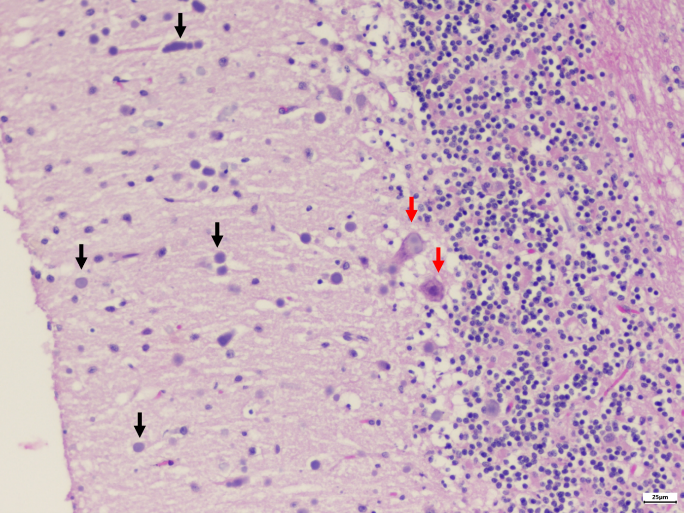
Lafora disease is a rare hereditary neurodegenerative encephalopathy characterized by the intracytoplasmic accumulation of abnormal polyglucosans resulting from alterations in glycogen metabolism, associated with mutations in the EPM2A (laforin) or NHLRC1/EPM2B (malin) genes. Although described in humans and in predisposed canine breeds such as Beagle, Basset Hound, and Miniature Wirehaired Dachshund, it remains underdiagnosed in mixed-breed dogs, partly due to the reliance on histopathological or genetic confirmation, which is often performed post mortem. This report describes the case of a 10-year-old mixed-breed female dog presenting with recurrent seizures, myoclonus, ataxia, and vestibular signs, in addition to relevant comorbidities. Histopathological examination revealed PAS-positive Lafora bodies, predominantly distributed in the cerebellum and brainstem, associated with mild neuronal necrosis and diffuse gliosis. The correlation between clinical progression and anatomopathological findings allowed the diagnosis of Lafora-type progressive myoclonic epilepsy. This report highlights the importance of including Lafora disease in the differential diagnosis of chronic neurological disorders in dogs, especially in animals without a defined breed predisposition, and emphasizes the need for an integrated diagnostic approach combining clinical evaluation, complementary examinations, and histochemical analysis for definitive confirmation.
References
Downloads
Published
Issue
Section
License
Copyright (c) 2026 Jenifer Caroline Borges Lima, Ana Paula Frederico Loureiro Bracarense

This work is licensed under a Creative Commons Attribution 4.0 International License.
Você tem o direito de:
Compartilhar — copiar e redistribuir o material em qualquer suporte ou formato
Adaptar — remixar, transformar, e criar a partir do material para qualquer fim, mesmo que comercial.
O licenciante não pode revogar estes direitos desde que você respeite os termos da licença. De acordo com os termos seguintes:
Atribuição
— Você deve dar o crédito apropriado, prover um link para a licença e indicar se mudanças foram feitas. Você deve fazê-lo em qualquer circunstância razoável, mas de nenhuma maneira que sugira que o licenciante apoia você ou o seu uso. Sem restrições adicionais
— Você não pode aplicar termos jurídicos ou medidas de caráter tecnológico que restrinjam legalmente outros de fazerem algo que a licença permita.