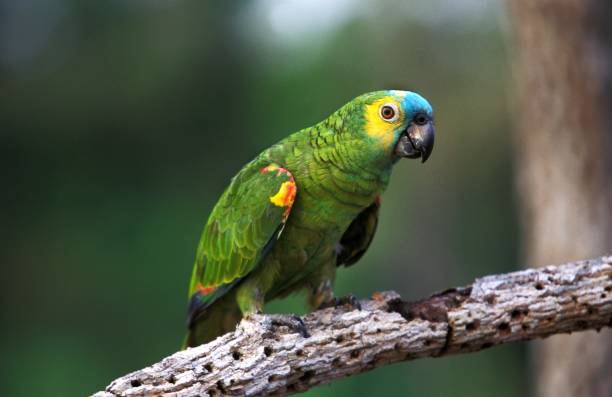
Use of tilapia (Oreochromis niloticus) skin scaffold in corneal ulcer repair in Amazona aestiva
Case report
DOI:
https://doi.org/10.31533/pubvet.v19n06e1792Keywords:
cornea, parrot, tilapia skinAbstract
his study aimed to evaluate the efficacy of an acellular protein matrix (scaffold) derived from Nile tilapia (Oreochromis niloticus) skin as a therapeutic alternative for the treatment of corneal ulcers in a turquoise-fronted amazon (Amazona aestiva) compared to conventional therapy. Corneal ulcers are common in small animal clinical practice and, in severe cases, require surgical intervention. However, accessible and effective treatment options remain limited. The scaffold, produced under strict biosafety standards, was applied to an adult male parrot with a corneal thickness loss of more than 80% and no response to previous treatments. The procedure involved general anesthesia, graft preparation with antisepsis, suturing over the lesion, application of antibiotic eye drops, and placement of a third eyelid flap. Postoperative observations included improved corneal transparency, absence of graft rejection, moderate vascularization followed by avascularization, good ocular lubrication (10 mm/min), preserved pupillary reflex, and intraocular pressure within the species' normal range. The scaffold functioned as structural support for complete tissue regeneration, promoting adequate epithelial adherence with no signs of infection, inflammation or discomfort. After 30 days, the parrot showed advanced corneal healing, conjunctival hyperemia without discomfort, and significant improvements to posture, mobility and behavior, returning to a normal feeding routine. The results indicate that tilapia skin scaffold is a highly compatible and safe biomaterial with a favorable cost-benefit ratio and potential for application in veterinary regenerative medicine, providing comfort and improved quality of life for animals. The successful outcome of this case reinforces the viability of this tissue scaffold for use in other species, establishing it as a promising innovation in veterinary ophthalmology.
References
Astuti, D., Azuma, N., Suzuki, H., & Higashi, S. (2006). Phylogenetic relationships within parrots (Psittacidae) inferred from mitochondrial cytochrome-b gene sequences. Zoological Science, 23(2), 191–198. https://doi.org/10.2108/zsj.23.191.
Caetano, C., Bremond, F., & Schwartz, W. R. (2019). Skeleton image representation for 3d action recognition based on tree structure and reference joints. Proceedings - 32nd Conference on Graphics, Patterns and Images, SIBGRAPI 2019. https://doi.org/10.1109/SIBGRAPI.2019.00011.
Campbell, T., Ritchie, B., & Harrison, L. (1994). Avian medicine, principles and aplication. In Avian medicine, principles and application.
Cohen, E. B., Lafleur, J. M., & Moore, F. R. (2022). Density Dependent Refueling of Migratory Songbirds During Stopover Within an Urbanizing Coastal Landscape. Frontiers in Ecology and Evolution, 10. https://doi.org/10.3389/fevo.2022.837790
CONCEA. (2016). Guia brasileiro de produção, manutenção. Consciência e senescência como fundamentos do direito animal. Revista Brasileira de Direito e Justiça, 6.
Davis, R. B., Harrison, G. J., & Harrison, L. R. (1987). Clinical avian medicine and surgery. Avian Diseases, 31(1). https://doi.org/10.2307/1590800.
Foote, A. R. (2021). Corneal ulcers part 1: Aetiology and management of superficial corneal ulcers. The Veterinary Nurse, 12(5). https://doi.org/10.12968/vetn.2021.12.5.226.
Fraga, R. M., & Mazar, B. J. (1997). Handbook of the Birds of the World. El Hornero, 14(4). https://doi.org/10.56178/eh.v14i4.987
Gargiulo, F. C. D. (2015). Particularidades oftálmicas em aves. Universidade de Brasília.
Gelatt, K. N., Ben-Shlomo, G., Gilger, B. C., Hendrix, D. V. H., Kern, T. J., & Plummer, C. E. (2021). Veterinary ophthalmology. John Wiley & Sons.
González-González, D. C., Rodríguez-Félix, D. E., García-Sifuentes, C. O., Castillo-Ortega, M. M., Encinas-Encinas, J. C., Santacruz Ortega, H. D. C., & Romero-García, J. (2022). Collagen scaffold derived from tilapia (Oreochromis niloticus) skin: Obtention, structural and physico-chemical properties. Journal of Aquatic Food Product Technology, 31(4). https://doi.org/10.1080/10498850.2022.2048332.
Greenwood, A. G. (1987). Clinical avian medicine and surgery. British Veterinary Journal, 143(4). https://doi.org/10.1016/0007-1935(87)90074-1,
Gurjão, T. A. (2023). Úlcera de córnea profunda em cães e equinos, uma abordagem clínica e cirúrgica: Revisão de literatura. Caderno Verde de Agroecologia e Desenvolvimento Sustentável, 12(2).
Hvenegaard, A. P., Safatle, A. M. V., Guimarães, M. B., Ferreira, A. J. P., & Barros, P. S. M. (2009). Retrospective study of ocular disorders in Amazon parrots. Pesquisa Veterinária Brasileira, 29(12), 979–984. https://doi.org/10.1590/s0100-736x2009001200005.
Korbel, R. T. (2011). Avian ophthalmology–Principles and application. Proceedings of the Association of Avian Veterinarians and the Association of Exotic Mammal Veterinarians (AEMV).
Lau, C. S., Hassanbhai, A., Wen, F., Wang, D., Chanchareonsook, N., Goh, B. T., Yu, N., & Teoh, S. H. (2019). Evaluation of decellularized tilapia skin as a tissue engineering scaffold. Journal of Tissue Engineering and Regenerative Medicine, 13(10). https://doi.org/10.1002/term.2928.
Li, J., Wang, M., Qiao, Y., Tian, Y., Liu, J., Qin, S., & Wu, W. (2018). Extraction and characterization of type I collagen from skin of tilapia (Oreochromis niloticus) and its potential application in biomedical scaffold material for tissue engineering. Process Biochemistry, 74. https://doi.org/10.1016/j.procbio.2018.07.009.
Lobo, T., Sant’Anna, A., Fayad, A., & Lima, A. (2021). A córnea e as ceratites ulcerativas em cães: Uma revisão da anatomia, etiopatogenia e diagnóstico. Enciclopédia Biosfera, 18(36). https://doi.org/10.18677/encibio_2021b2.
Melo, M. S., Vieira Neto, A. E., Wouk, A. F. P. F., Evangelista, J. S. A. M., Morais, G. B., Moraes, M. E. A., & Moraes Filho, M. O. (2022). Enxerto de pele de tilápia (Oreochromis niloticus) em reparo de úlcera em córnea de cão: relato de caso. Brazilian Journal of Animal and Environmental Research, 5(1), 367–375. https://doi.org/10.51161/convesp/5827.
Miranda, L. G., Silva, E. B., Alencar, S. P., Sá, F. B., Ferreira, M. D. P. F., & Silva, J. P. G. (2023). Ceratoconjuntivite eosinofílica em felino: Relato de caso. PUBVET, 17(6), e1404. https://doi.org/10.31533/pubvet.v17n6e1404.
Orcutt, C. (2016). Ophthalmology of exotic pets. Journal of Exotic Pet Medicine, 25(2). https://doi.org/10.1053/j.jepm.2016.03.006.
Paul-Murphy, J., Harrison, G. J., & Harrison, L. R. (1987). Clinical avian medicine and surgery. The Journal of Zoo Animal Medicine, 18(2/3). https://doi.org/10.2307/20460251.
Schuerch, K., Baeriswyl, A., Frueh, B. E., & Tappeiner, C. (2020). Efficacy of amniotic membrane transplantation for the treatment of corneal ulcers. Cornea, 39(4), 479–483. https://doi.org/10.1097/ICO.0000000000002179.
Schweizer, M., Seehausen, O., Güntert, M., & Hertwig, S. T. (2010). The evolutionary diversification of parrots supports a taxon pulse model with multiple trans-oceanic dispersal events and local radiations. Molecular Phylogenetics and Evolution, 54(3), 984–994. https://doi.org/10.1016/j.ympev.2009.08.021
Stiles, J. (2020). Therapeutic update on infectious keratitis in small animals. Veterinary Clinics: Small Animal Prectice, 50(3), 517–531.
Stiles, J., & Kimmitt, B. (2016). Eye examination in the cat: Step-by-step approach and common findings. Journal of Feline Medicine and Surgery, 18(9), 702–711. https://doi.org/10.1177/1098612X16660444.
Vilela, D. A. R. (2012). Diagnóstico da situação dos animais silvestres recebidos nos CETAS brasileiros e chlamydophila psittaci em papagaios Amazona aestiva no CETAS de Belo Horizonte. Universidade Federal de Minas Gerais.
Vygantas, K. R., & Whitley, R. D. (2003). Management of deep corneal ulcers. Compendium on Continuig Education for the Practisng Veterinarian Education, 25(3), 196–205.
Williams, D. L. (2013). Ophthalmology of exotic pets. In Ophthalmology of Exotic Pets. https://doi.org/10.1002/9781118709627.
Downloads
Published
Issue
Section
License
Copyright (c) 2025 Mirza de Souza Melo, Sofphia Martins da Silva, Prof. Dr. Antonio Eufrásio Vieira Neto, Maria Elisabete Amaral de Moraes, Edmar Maciel Lima Júnior, Felipe Augusto Rocha Rodrigues, Carlos Roberto Koscky Paier, Manoel Odorico de Moraes Filho

This work is licensed under a Creative Commons Attribution 4.0 International License.
Você tem o direito de:
Compartilhar — copiar e redistribuir o material em qualquer suporte ou formato
Adaptar — remixar, transformar, e criar a partir do material para qualquer fim, mesmo que comercial.
O licenciante não pode revogar estes direitos desde que você respeite os termos da licença. De acordo com os termos seguintes:
Atribuição
— Você deve dar o crédito apropriado, prover um link para a licença e indicar se mudanças foram feitas. Você deve fazê-lo em qualquer circunstância razoável, mas de nenhuma maneira que sugira que o licenciante apoia você ou o seu uso. Sem restrições adicionais
— Você não pode aplicar termos jurídicos ou medidas de caráter tecnológico que restrinjam legalmente outros de fazerem algo que a licença permita.