Osteosynthesis of a type III sacral fracture using screws and polymethylmethacrylate in a cat
Case report
DOI:
https://doi.org/10.31533/pubvet.v20n6e1967Keywords:
Caudectomy, sacroiliac disruption, neurapraxia, sacrum, traumaAbstract
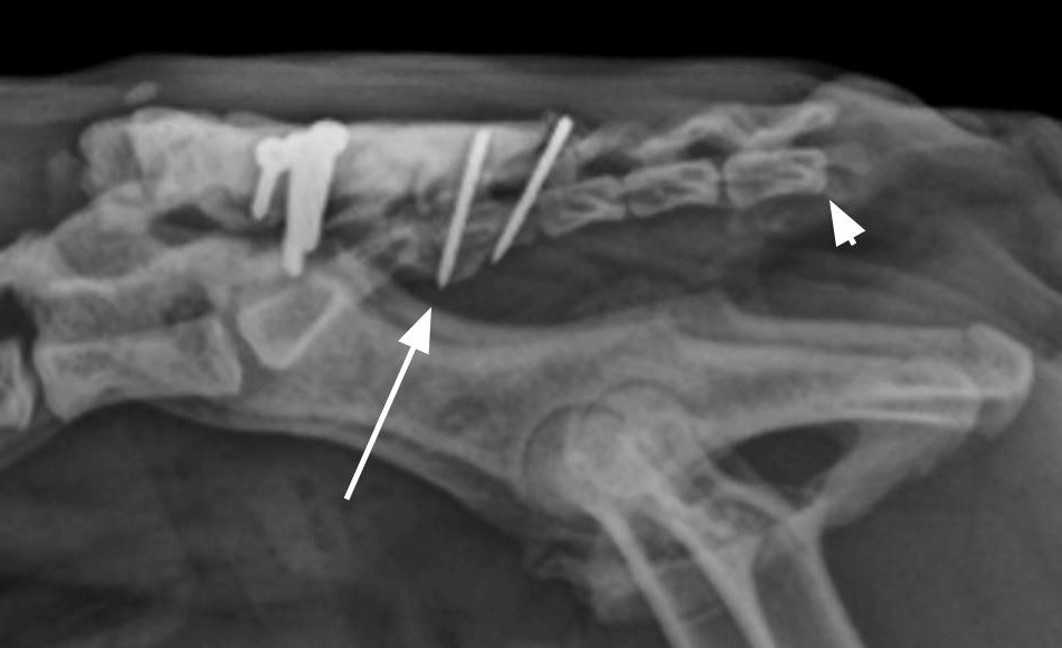
. Sacral fractures account for approximately 3% of axial skeletal fractures in small animals and are frequently associated with pelvic fractures, usually resulting from high-energy trauma. In veterinary medicine, the most widely used classification divides these fractures into five types according to their location and the anatomical structures involved. Clinical manifestations vary according to the degree of neurological impairment and may include pain, pelvic limb paresis, altered reflexes, tail flaccidity, and urinary and fecal dysfunction. Treatment depends on the degree of vertebral displacement and the presence of neurological deficits, with osteosynthesis techniques, particularly the use of screws associated with polymethylmethacrylate (PMMA), being the preferred surgical approach. Absence of tail sensation and urinary dysfunction are associated with a poorer prognosis. This report describes the case of a domestic cat diagnosed with a type III (transverse) sacral fracture following a vehicular accident, treated at the Veterinary Hospital of the State University of Londrina. The patient underwent sacral osteosynthesis using screws and polymethylmethacrylate (PMMA), with a satisfactory clinical outcome. At the time of writing (90 days after surgery), the patient remains free of neurological sequelae.
References
Anderson, A., & Coughlan, A. R. (1997). Sacral fractures in dogs and cats: A classification scheme and review of 51 cases. Journal of Small Animal Practice, 38(9), 404–409. https://doi.org/10.1111/j.1748-5827.1997.tb03493.x.
Çatalkaya, E., Yayla, S., Altan, S., Ersöz, K. B., Saylak, N., & Hatipoglu, Ş. (2024). A Retrospective Study on Pelvic Fractures in Cats and Dogs (2020-2022). Kocatepe Veterinary Journal, 15–21. https://doi.org/10.30607/kvj.1370455.
Davies, E., & Walmsley, G. (2011). Management of tail pull injuries in cats. In Practice, 34(1), 27–33. https://doi.org/10.1136/inp.d7449.
Flores, J. A., Rovesti, G. L., & Rodriguez-Quiros, J. (2023). External Fixation for Fracture Stabilization of the Sacrum in 15 Dogs. Frontiers in Veterinary Science, 10, e1222504. https://doi.org/10.3389/fvets.2023.1222504.
Garcia, M., Dumartinet, C., Bernard, F., & Bernardé, A. (2021). Outcomes of nine cats with urinary retention after sacrocaudal luxation managed with long-term urinary diversion. Veterinary Surgery, 50(8), 1681–1687. https://doi.org/10.1111/vsu.13695.
Gernone, F., Uva, A., Maiolini, A., & Zatelli, A. (2022). A review of the neural control of micturition in dogs and cats: neuroanatomy, neurophysiology and neuroplasticity. Veterinary Research Communications, 46(4), 991–998. https://doi.org/10.1007/s11259-022-09966-9.
Kuntz, C. A., Waldron, D., Martin, R. A., Shires, P. K., Moon, M., & Shell, L. (1995). Sacral fractures in dogs: a review of 32 cases. Journal of the American Animal Hospital Association, 31(2), 142–150. https://doi.org/10.5326/15473317-31-2-142.
Marques, A. L. R. M., Marangoni, M., Meznerovicz, A. F. F., Gonçalves, G. F., & Braz, P. H. (2025). Multimodal anesthesia in a margay (Leopardus wiedii) for sacralosteosynthesis. Brazilian Journal of Veterinary Research and Animal Science, 62. https://doi.org/10.11606/issn.1678-4456.bjvras.2025.235091.
Meeson, R. L., & Geddes, A. T. (2017). Management and long-term outcome of pelvic fractures: A retrospective study of 43 cats. Journal of Feline Medicine and Surgery, 19(1), 36–41. https://doi.org/10.1177/1098612X15606958.
Neres, H. G. C., Ramos, L. P., Oliveira, J. N., Santos, D. L., & Oliveira, L. M. (2022). Redução de Luxação Sacroilíaca em Felino: Relato de Caso. Revista Sustinere, 10. https://doi.org/10.12957/sustinere.2022.65863.
Pilot, M. A., & Langley-Hobbs, S. J. (2022). Nerve root signature in a cat: Presentation and treatment following acetabular fracture stabilisation and sacral fracture displacement. Veterinary Record Case Reports, 10(4), e484. https://doi.org/10.1002/vrc2.484.
Smeak, D. D., & Olmsted, M. L. (1985). Fracture/Luxations of the Sacrococcygeal Area in the Cat: A Retrospective Study of 51 Cases. Veterinary Surgery, 14(4), 319–326. https://doi.org/10.1111/j.1532-950X.1985.tb00895.x.
Sun, N., Liu, Y., Yan, H., Zhang, Z., Li, Y., & Zeng, C. (2023). Recent Progress in the Classification and Operation of Sacral Fractures. Emergency Medicine International, 2023, 2795722. https://doi.org/10.1155/2023/2795722.
Tatton, B., Jeffery, N., & Holmes, M. (2009). Predicting recovery of urination control in cats after sacrocaudal injury: A prospective study. Journal of Small Animal Practice, 50(11), 593–596. https://doi.org/10.1111/j.1748-5827.2009.00770.x.
Vardanega, M. J., & Wilson, L. (2024). Sacral fracture stabilisation using dorsal transiliac locking plates: 12 cases (2017-2023). Journal of Small Animal Practice, 65(4), 251–260. https://doi.org/10.1111/jsap.13711.
Wilson, L. (2015). Repair of sacral fractures using pins and polymethylmethacrylate (six cases). Australian Veterinary Journal, 93(9), 311–318. https://doi.org/10.1111/avj.12310.
Downloads
Published
Issue
Section
License
Copyright (c) 2026 Caique Marques Rocha Oliveira, Mônica Vicky Bahr Arias

This work is licensed under a Creative Commons Attribution 4.0 International License.
Você tem o direito de:
Compartilhar — copiar e redistribuir o material em qualquer suporte ou formato
Adaptar — remixar, transformar, e criar a partir do material para qualquer fim, mesmo que comercial.
O licenciante não pode revogar estes direitos desde que você respeite os termos da licença. De acordo com os termos seguintes:
Atribuição
— Você deve dar o crédito apropriado, prover um link para a licença e indicar se mudanças foram feitas. Você deve fazê-lo em qualquer circunstância razoável, mas de nenhuma maneira que sugira que o licenciante apoia você ou o seu uso. Sem restrições adicionais
— Você não pode aplicar termos jurídicos ou medidas de caráter tecnológico que restrinjam legalmente outros de fazerem algo que a licença permita.