Traumatic brain injury in a dog
Case report
DOI:
https://doi.org/10.31533/pubvet.v20n9e2002Keywords:
Emergency care, dogs, veterinary neurology, neurotrauma, traumatic brain injuryAbstract
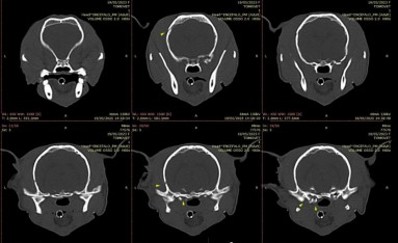
Traumatic brain injury (TBI) is a serious neurological condition frequently encountered in veterinary medicine and is primarily associated with vehicular accidents, falls, and physical trauma. The condition involves both primary and secondary brain injuries, which may result in severe neurological impairment and a guarded prognosis. This study aimed to report the clinical case of an intact mixed-breed female dog, approximately two years of age, admitted to a veterinary hospital in Juiz de Fora, Minas Gerais, Brazil, with a clinical suspicion of TBI. The patient presented with otorrhagia, bilateral epistaxis, mydriasis, seizures, tachycardia, tachypnea, and neurological abnormalities consistent with severe traumatic brain injury. Following clinical and neurological evaluation, emergency stabilization, analgesia, intracranial pressure control, and intensive supportive care were instituted. Radiographic examinations revealed cranial fractures, while computed tomography confirmed a supratentorial brain injury. During hospitalization, the patient received intensive pharmacological treatment, nutritional support, and neurological monitoring, showing progressive clinical improvement. The case discussion highlighted the importance of controlling intracranial pressure, maintaining cerebral perfusion, and providing early therapeutic intervention to minimize secondary brain injury. Despite persistent motor deficits and suspected hearing impairment at discharge, the patient showed clinical improvement and partial recovery of neurological function. This case highlights the importance of prompt, intensive, multidisciplinary care, combined with continuous assessment of treatment response, to guide the clinical management of patients with TBI.
References
Amadori, A. (2020). Emergência em Traumatologia (1st ed., Vol. 1). Contentus.
Bagley, R. S., Keegan, R. D., Greene, S. A., Harrington, M. L., & Moore, M. P. (1995). Pathologic effects in brain after intracranial pressure monitoring in clinically normal dogs, using a fiberoptic monitoring system. American Journal of Veterinary Research, 56(11), 1475–1478. https://doi.org/10.2460/ajvr.1995.56.11.1475.
Branco, S. E. M. T., Torres, B. B. J., & Martins, B. C. (2013). Trauma cranioencefálico em pequenos animais - considerações terapêuticas. Cadernos Técnicos da Veterinária e Zootecnia, 69(97), 50–61.
Clifton, G. L., Miller, E. R., Choi, S. C., & Levin, H. S. (2002). Fluid thresholds and outcome from severe brain injury. Critical Care Medicine, 30(4), 739–745. https://doi.org/10.1097/00003246-200204000-00003.
Ettinger, S. J., Feldman, E. C., & Cote, E. (2017). Textbook of Veterinary Internal Medicine-eBook. Elsevier Health Sciences.
Fraga, I. dos S., Almeida, N. G. P. A., & Rezende, A. A. (2018). Craniectomia descompressiva de urgência para a sobrevivência de pacientes caninos vítimas de traumatismo crânio-encefálico grave. Pubvet, 12(2), 1–10. https://doi.org/10.22256/pubvet.v12n2a30.1-10.
Francony, G., Fauvage, B., Falcon, D., Canet, C., Dilou, H., Lavagne, P., Jacquot, C., & Payen, J. F. (2008). Equimolar doses of mannitol and hypertonic saline in the treatment of increased intracranial pressure. Critical Care Medicine, 36(3), 795. https://doi.org/10.1097/CCM.0B013E3181643B41.
Gomes, P. M. B. (2011). Traumatismo craniano: contribuição da craniectomia descompressiva para a sobrevivência de pacientes caninos com hipertensão intracraniana traumática refractária ao tratamento médico: estudo retrospectivo. Universidade Técnica de Lisboa.
Gwak, D. S., & Ko, S. B. (2023). Hyperosmolar therapy for regulation of cerebral edema and intracranial pressure. Journal of the Korean Medical Association, 66(5). https://doi.org/10.5124/jkma.2023.66.5.297.
Mangat, H. S. (2018). Hypertonic saline infusion for treating intracranial hypertension after severe traumatic brain injury. Critical Care, 22(1). https://doi.org/10.1186/s13054-018-1963-7.
Moura, G. R. F., Silva, I. B., & Mendanha Neto, L. (2020). Abordagem do neurotrauma – traumatismo cranioencefálico (TCE). In G. B. L. de Freitas (Ed.), Trauma e emergência (Vol. 2, pp. 71–79). Editora Pasteur. https://doi.org/10.29327/526021.
Mussi, H. G., Rezende, B. E. S., Caciquinho, I. B., Félix, L. C. S., Pessoa, L. S. G., Weinem, M. C. F., Cerceau, M. P. B., Santos, J. P. R., Queiroz, J. G. V., & Reis, B. L. (2023). Métodos não invasivos para monitorização da pressão intracraniana: uma revisão atual. Revista Eletrônica Acervo Saúde, 23(1). https://doi.org/10.25248/reas.e11450.2023.
Ortiz, M. R. (2017). Hypoglycemia in Diabetes. Nursing Clinics of North America, 52(4). https://doi.org/10.1016/j.cnur.2017.07.006.
Ramos, R. M., & Ferreira, D. R. C. (2022). Trauma cranioencefálico em cães e gatos. In Promevet: Pequenos Animais: Programa de Atualização em Medicina Veterinária: Ciclo 7: Volume 4. https://doi.org/10.5935/978-65-5848-612-1.c0005.
Ropper, A. H. (2012). Hyperosmolar Therapy for Raised Intracranial Pressure. New England Journal of Medicine, 367(8), 746–752. https://doi.org/10.1056/nejmct1206321.
Santos, L. O., Caldas, G. G., Santos, C. R. O., & Júnior, D. B. (2018). Traumatic brain injury in dogs and cats: A systematic review. Veterinarni Medicina, 63(8). https://doi.org/10.17221/20/2017-VETMED.
Sousa, Y. A., Pires, S. S., & Pinto, S. C. C. (2024). Trauma crânio-Encefálico com edema - relato de caso. Revista Foco, 17(9). https://doi.org/10.54751/revistafoco.v17n9-086.
Sturges, B. K., Dickinson, P. J., Tripp, L. D., Udaltsova, I., & LeCouteur, R. A. (2019). Intracranial pressure monitoring in normal dogs using subdural and intraparenchymal miniature strain-gauge transducers. Journal of Veterinary Internal Medicine, 33(2). https://doi.org/10.1111/jvim.15333.
White, H., Cook, D., & Venkatesh, B. (2006). The use of hypertonic saline for treating intracranial hypertension after traumatic brain injury. Anesthesia and Analgesia, 102(6), 1836–1846. https://doi.org/10.1213/01.ane.0000217208.51017.56.
Wilson, M. (2026). Final Results of MRC CRASH, a Randomised Placebo-Controlled Trial of Intravenous Corticosteroid in Adults with Head Injury – Outcomes at 6 Months. In Coresource 4. https://doi.org/10.1201/9781003416197-38.
Downloads
Published
Issue
Section
License
Copyright (c) 2026 Lyvia Carneiro de Oliveira; Marina Lobo Mateus de Oliveira, Alessandra Alevato Leal, Francisco José Sayão Lobato Brum de Barros

This work is licensed under a Creative Commons Attribution 4.0 International License.
Você tem o direito de:
Compartilhar — copiar e redistribuir o material em qualquer suporte ou formato
Adaptar — remixar, transformar, e criar a partir do material para qualquer fim, mesmo que comercial.
O licenciante não pode revogar estes direitos desde que você respeite os termos da licença. De acordo com os termos seguintes:
Atribuição
— Você deve dar o crédito apropriado, prover um link para a licença e indicar se mudanças foram feitas. Você deve fazê-lo em qualquer circunstância razoável, mas de nenhuma maneira que sugira que o licenciante apoia você ou o seu uso. Sem restrições adicionais
— Você não pode aplicar termos jurídicos ou medidas de caráter tecnológico que restrinjam legalmente outros de fazerem algo que a licença permita.