Appendicular osteosarcoma in a female dog: diagnosis, multimodal treatment, and clinical follow-up
DOI:
https://doi.org/10.31533/pubvet.v20n9e2007Keywords:
Amputation, bone neoplasm, chemotherapy, dogs, doxorubicin, osteosarcomaAbstract
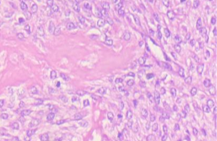
Appendicular osteosarcoma is a malignant bone neoplasm characterized by aggressive biological behavior and a high metastatic potential in dogs. This study aimed to report the diagnosis, treatment, and clinical follow-up of a female dog with appendicular osteosarcoma. A 12-year-old spayed mixed-breed female dog weighing 12.8 kg was presented with progressive lameness and pain in the right thoracic limb. Radiographic examination revealed a bone lesion in the proximal humeral diaphysis and, due to progressive pain, limb amputation was performed. Histopathological examination of the surgical specimen confirmed the diagnosis of osteosarcoma, characterized by a mesenchymal neoplastic proliferation with marked cellular pleomorphism, high mitotic activity, and osteoid matrix production. Staging revealed no evidence of metastasis, and the patient underwent six sessions of adjuvant chemotherapy with doxorubicin. During treatment, mild and transient adverse events were observed, including gastrointestinal signs and coat darkening, with no need for dose reduction or treatment interruption. After approximately nine months of follow-up, the patient remained clinically stable, with good quality of life and no evidence of local recurrence or metastasis on follow-up examinations. This case highlights the importance of a multimodal approach combining surgical management with systemic therapy, as well as clinical and imaging follow-up, in the management of canine appendicular osteosarcoma.
References
Berg, J. (1996). Canine osteosarcoma: Amputation and chemotherapy. Veterinary Clinics of North America: Small Animal Practice, 26(1), 111–121. https://doi.org/10.1016/S0195-5616(96)50010-0.
Bryan, J. N. (2024). Updates in Osteosarcoma. Veterinary Clinics of North America - Small Animal Practice, 54(3), 523–539. https://doi.org/10.1016/j.cvsm.2023.12.007.
Chaves, L. D. C. S., Silva, F. L., Silva, C. R. A., Sousa, J. M. C., Oliveira, J. R. A., Silva, L. S., & Santos, L. P. (2020). Osteossarcoma em cão Border Collier. PUBVET, 14(1), 1–5. https://doi.org/10.31533/pubvet.v14n1a492.1-5.
Falk, E. F., Lam, A. T. H., Barber, L. G., & Ferrer, L. (2017). Clinical characteristics of doxorubicin-associated alopecia in 28 dogs. Veterinary Dermatology, 28(2), 207. https://doi.org/10.1111/vde.12409.
Gugelmin, G. A., Barreto, L. S., Ruiz, D. A., Barros, R. M., & Cotta, T. R. (2020). Osteossarcoma apendicular condroblástico em cão da raça Dachshund. Brazilian Journal of Animal and Environmental Research, 3(3), 2203–2209. https://doi.org/10.37423/201003006.
Miyagi, H., Coutermarsh-Ott, S., Selmic, L. E., Campuzano, S., Raybuck, M., Ciepluch, B., & Tuohy, J. (2026). Histological prognostic factors in canine appendicular osteosarcoma: 57 cases (2014–2022). Scientific Reports, 16(1), 542. https://doi.org/10.1038/s41598-025-29917-z.
Morello, E., Martano, M., & Buracco, P. (2011). Biology, diagnosis and treatment of canine appendicular osteosarcoma: Similarities and differences with human osteosarcoma. In Veterinary Journal (Vol. 189, Number 3, pp. 268–277). https://doi.org/10.1016/j.tvjl.2010.08.014.
Nemanic, S., London, C. A., & Wisner, E. R. (2006). Comparison of thoracic radiographs and single breath‐hold helical CT for detection of pulmonary nodules in dogs with metastatic neoplasia. Journal of Veterinary Internal Medicine, 20(3), 508–515. https://doi.org/10.1111/j.1939-1676.2006.tb02889.x.
Polton, G., Borrego, J. F., Clemente-Vicario, F., Clifford, C. A., Jagielski, D., Kessler, M., Kobayashi, T., Lanore, D., Queiroga, F. L., Rodrigues, L., Rowe, A. T., Vajdovich, P., & Bergman, P. J. (2025). Osteosarcoma of the appendicular skeleton in dogs: consensus and guidelines. Frontiers in Veterinary Science, 12. https://doi.org/10.3389/fvets.2025.1633593.
Selmic, L. E., Burton, J. H., Thamm, D. H., Withrow, S. J., & Lana, S. E. (2014). Comparison of carboplatin and doxorubicin-based chemotherapy protocols in 470 dogs after amputation for treatment of appendicular osteosarcoma. Journal of Veterinary Internal Medicine, 28(2), 554–563. https://doi.org/10.1111/jvim.12313.
Szewczyk, M., Lechowski, R., & Zabielska, K. (2015). What do we know about canine osteosarcoma treatment? – review. Veterinary Research Communications, 39(1), 61–67. https://doi.org/10.1007/s11259-014-9623-0.
Downloads
Published
Issue
Section
License
Copyright (c) 2026 Amanda Braga Eliziário, Caroline Freitas Souza, Clara de Almeida Mendes, Heloísia Maria Bressan Braz, Bruno de Tullio Augusto Roque Lima

This work is licensed under a Creative Commons Attribution 4.0 International License.
Você tem o direito de:
Compartilhar — copiar e redistribuir o material em qualquer suporte ou formato
Adaptar — remixar, transformar, e criar a partir do material para qualquer fim, mesmo que comercial.
O licenciante não pode revogar estes direitos desde que você respeite os termos da licença. De acordo com os termos seguintes:
Atribuição
— Você deve dar o crédito apropriado, prover um link para a licença e indicar se mudanças foram feitas. Você deve fazê-lo em qualquer circunstância razoável, mas de nenhuma maneira que sugira que o licenciante apoia você ou o seu uso. Sem restrições adicionais
— Você não pode aplicar termos jurídicos ou medidas de caráter tecnológico que restrinjam legalmente outros de fazerem algo que a licença permita.