Nasal adenocarcinoma in a dog: contribution of frozen-section histopathology to intraoperative diagnosis and radiotherapy
DOI:
https://doi.org/10.31533/pubvet.v20n9e2005Keywords:
Intraoperative diagnosis, frozen-section histopathology, nasal neoplasia, radiotherapyAbstract
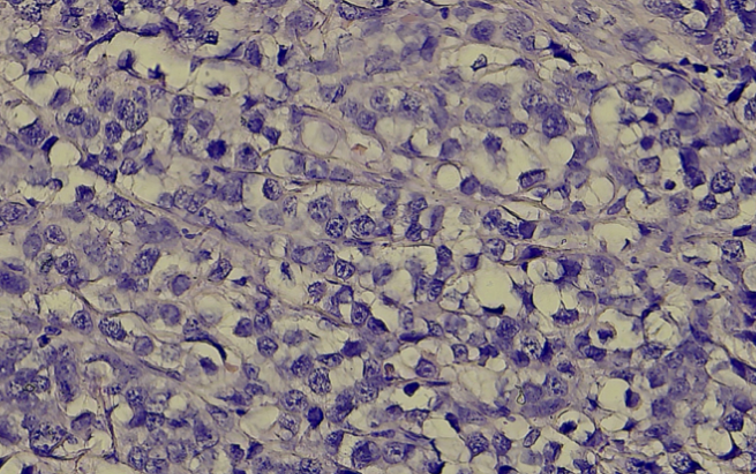
Nasal neoplasms are uncommon in dogs but exhibit a high rate of malignancy, with carcinomas representing the most frequently diagnosed tumor type. They occur predominantly in male dogs with dolichocephalic and mesocephalic skull conformations. This report describes a case of nasal adenocarcinoma in a 12-year-old male West Highland White Terrier diagnosed by intraoperative frozen-section histopathology and the effects of radiotherapy on tumor control. Radiographic and computed tomography examinations revealed an expansile soft-tissue mass associated with destruction of the nasal and frontal bones, invasion of the paranasal sinuses, and involvement of the cribriform plate, with mild intracranial extension. Given the extent and location of the lesion, complete surgical resection was considered unfeasible because of the high risk of neurological and intracranial complications. During surgery, a biopsy specimen was obtained and submitted for intraoperative frozen-section histopathological evaluation, allowing the immediate diagnosis of nasal adenocarcinoma and supporting therapeutic decision-making. After discussion of the available treatment options with the owner, radiotherapy was selected as the treatment of choice for local control of nasal neoplasms that were not amenable to complete surgical resection. Owing to the locally advanced stage of the disease, a palliative radiotherapy protocol was instituted according to the recommendations of the specialized oncology team. Follow-up imaging demonstrated a reduction in tumor volume after radiotherapy. Subsequently, the patient developed neurological signs and marked clinical deterioration and was euthanized on August 23, 2026, after 136 days of follow-up. This case highlights the value of frozen-section histopathology for intraoperative diagnosis and therapeutic decision-making, as well as the favorable local response achieved with radiotherapy.
References
Ad’Vincula, H. L., Goulart, L. C. C., Carvalho, T. S., Dornellas, W. S., Melo, R. G., & Ribeiro, L. S. (2024). Aspectos cirúrgicos de um condrossarcoma em cavidade nasal de cão. PUBVET, 18(02), e1547. https://doi.org/10.31533/pubvet.v18n02e1547.
Alvarez-Sanchez, A., Townsend, K. L., Gorman, E., Milovancev, M., & Russell, D. S. (2026). Performance of Frozen Section Histopathology, Imprint Cytology and Fine-Needle Aspirates for Detecting Canine Metastatic Mast Cell Tumour. Veterinary and Comparative Oncology, 24(1), 29–40. https://doi.org/10.1111/vco.70023.
Cabral, I., Rigas, K., Mason, S., Benoit, J., & Elliott, J. (2025). A Retrospective Evaluation of a Cyclical, Hypofractionated Radiotherapy Protocol (‘Quad-Shot’) for the Treatment of Canine Nasal Tumours in 81 Dogs. Veterinary and Comparative Oncology, 23(4), 606–615. https://doi.org/10.1111/vco.70013.
Cunha, S. C. S., Angelim, B. M., Herdade, R., Dias, K. C. S. R., Linhares, L. C. M., Bitencourt, R. C., Bispo, G. A., Paiva, F. N., & Nardi, A. B. (2026). Evaluation of Clinical Outcomes in Dogs with Malignant Intranasal Tumors Treated with Radiotherapy: A Retrospective Study of 40 Cases. Cancers, 18(12). https://doi.org/10.3390/cancers18122013.
Ehling, T. J., Klein, M. K., Smith, L., Prescott, D., Haney, S., Looper, J., LaDue, T., Brawner, W., Fidel, J., Shiomitsu, K., Green, E., Saba, C., Turek, M., & Farrelly, J. (2022). A prospective, multi-centre, Veterinary Radiation Therapy Oncology Group study reveals potential efficacy of toceranib phosphate (Palladia) as a primary or adjuvant agent in the treatment of canine nasal carcinoma. Veterinary and Comparative Oncology, 20(1), 293–303. https://doi.org/10.1111/vco.12776.
Fu, D. R., Weng, H. Y., Valenzuela, C. R. M., Vanhaezebrouck, I. F., & Plantenga, J. M. (2023). Retrospective comparison of side effects and outcomes of three-dimensional conformal vs. intensity-modulated radiation therapy in the palliative-intent treatment (4 Gy × 5 daily fractions) of canine intranasal tumors (2010–2017). Frontiers in Veterinary Science, 10. https://doi.org/10.3389/fvets.2023.1011949.
Hayes, A., Wong, H., Preston, A., & Dobson, J. (2025). A Single Institution Retrospective Comparison of Two Radiotherapy Protocols for the Palliative Treatment of Canine Nasal Carcinoma. Veterinary Radiology and Ultrasound, 66(6), e70097. https://doi.org/10.1111/vru.70097.
Iseri, T., Horikirizono, H., Abe, M., Itoh, H., Sunahara, H., Nemoto, Y., Itamoto, K., Tani, K., & Nakaichi, M. (2022). Outcomes of megavoltage radiotherapy for canine intranasal tumors and its relationship to clinical stages. Open Veterinary Journal, 12(3), 383–390. https://doi.org/10.5455/OVJ.2022.v12.i3.12.
Korimerla, N., & Wahl, D. R. (2022). Interactions between Radiation and One-Carbon Metabolism. International Journal of Molecular Sciences, 23(3), 1919. https://doi.org/10.3390/ijms23031919.
Malinowski, C. (2006). Canine and feline nasal neoplasia. Clinical Techniques in Small Animal Practice, 21(2), 89–94. https://doi.org/10.1053/j.ctsap.2005.12.016.
Mizuno, R., & Mori, T. (2024). Prognostic factors and survival following radiation therapy for canine nasal tumors: A single-institution retrospective study of 166 cases. Open Veterinary Journal, 14(7), 1538–1552. https://doi.org/10.5455/OVJ.2024.v14.i7.3.
Montenegro, M. F., González-Guerrero, R., Sánchez-del-Campo, L., Piñero-Madrona, A., Cabezas-Herrera, J., & Rodríguez-López, J. N. (2020). PRMT1-dependent methylation of BRCA1 contributes to the epigenetic defense of breast cancer cells against ionizing radiation. Scientific Reports, 10(1), 13275. https://doi.org/10.1038/s41598-020-70289-3.
Pavelski, M., Silva, D. M., & Froes, T. R. (2016). Radiografia das cavidades craniana e nasal em afecções neoplásicas em cães: características e limitações. Veterinária e Zootecnia, 23(2), 164–173.
Reif, J. S., Bruns, C., & Lower, K. S. (1998). Cancer of the nasal cavity and paranasal sinuses and exposure to environmental tobacco smoke in pet dogs. American Journal of Epidemiology, 147(5), 488–492. https://doi.org/10.1093/oxfordjournals.aje.a009475.
Sousa, F. G., Milioli, G., Neto, J. A., Felice, F., Chaves, G., Pereira, M., Lopes, H., Wronski, J., Nakagaki, K., & Beier, S. (2025). Intraoperative Frozen Section Biopsy for the Auxiliary Diagnosis of Transmural Intestinal Intermediate T-Cell Canine Lymphoma. Veterinary Sciences, 12(2), 104. https://doi.org/10.3390/vetsci12020104.
Worley, D. R. (2016). Nose and nasal planum neoplasia, reconstruction. Veterinary Clinics of North America - Small Animal Practice, 46(4), 735–750. https://doi.org/10.1016/j.cvsm.2016.02.005.
Downloads
Published
Issue
Section
License
Copyright (c) 2026 Heloísia Maria Bressan Braz, Amanda Braga Eliziário, Clara de Almeida Mendes, Caroline Freitas Souza, Bruno de Tullio Augusto Roque Lima, Idelvania dos Anjos Nonato

This work is licensed under a Creative Commons Attribution 4.0 International License.
Você tem o direito de:
Compartilhar — copiar e redistribuir o material em qualquer suporte ou formato
Adaptar — remixar, transformar, e criar a partir do material para qualquer fim, mesmo que comercial.
O licenciante não pode revogar estes direitos desde que você respeite os termos da licença. De acordo com os termos seguintes:
Atribuição
— Você deve dar o crédito apropriado, prover um link para a licença e indicar se mudanças foram feitas. Você deve fazê-lo em qualquer circunstância razoável, mas de nenhuma maneira que sugira que o licenciante apoia você ou o seu uso. Sem restrições adicionais
— Você não pode aplicar termos jurídicos ou medidas de caráter tecnológico que restrinjam legalmente outros de fazerem algo que a licença permita.