Teaching collections of biological specimens and synthetic models in veterinary parasitology education
Experience report
DOI:
https://doi.org/10.31533/pubvet.v20n9e2001Keywords:
Parasitological collection, active learning methodologies, parasitesAbstract
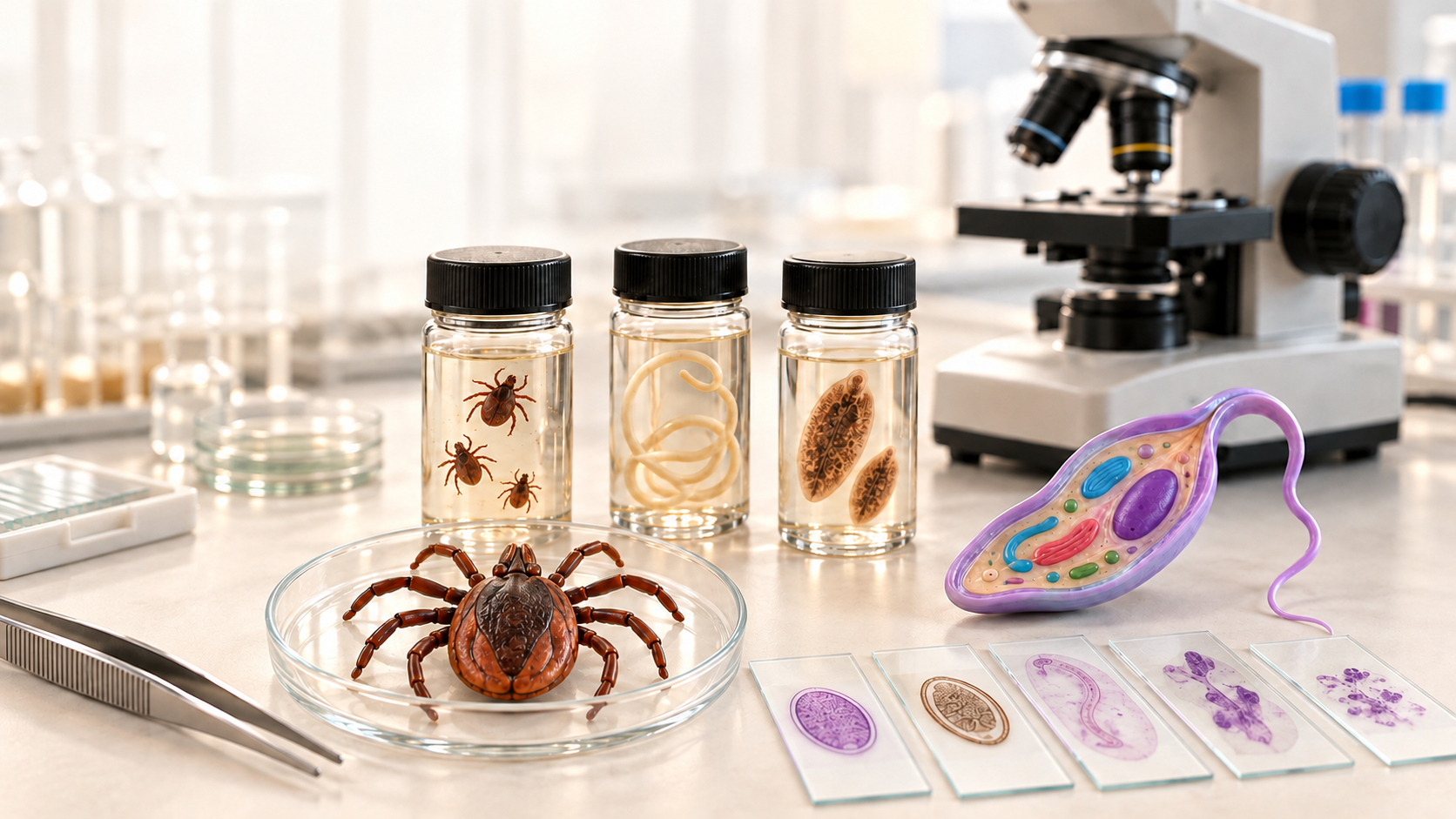
The teaching of Veterinary Parasitology faces challenges related to the limited availability of parasitological collections in higher education institutions. This study aimed to report a practical teaching experience based on the development of didactic collections composed of organic specimens and synthetic models of different parasites, with the objective of fostering technical and behavioral skills related to teamwork, which are essential for professional training. Thirty-four undergraduate students participated in the activity, organized into 13 research teams that collectively produced and presented 141 samples, grouped according to their cellular characteristics, nutritional modes, and phylogenetic relationships. Direct observation of real parasitic specimens remains the gold standard in the teaching–learning process; however, enlarged three-dimensional models made from biscuit modeling clay demonstrated considerable pedagogical value in Veterinary Medicine education. The combined use of real specimens and handcrafted models expanded learning opportunities, stimulated interest in research, and reinforced essential knowledge for the identification, prevention, and control of parasitic diseases.
References
Boch, J. V., & Superrer, R. (2014). Parasitología en medicina veterinaria. Hemisferio Sur, 1(Medicina veterinaria).
Bowman, D. D. (2010). Parasitologia veterinária. Elsevier.
Carneiro, F. de L., Gurjão, T. A., Santos, J. de J. C. dos, Santos, S. C. L., Bezerra, B. de F. G., Furtado, B. C., Nascimento, E. G. F. do, Nascimento, J. E. F. do, Clementino Neto, J., & Espíndola, J. C. A. de. (2025). Do mito à microscopia: Etnoconhecimento, filosofia natural e a formação do olhar parasitológico na Medicina Veterinária. Revista Brasileira de Filosofia e História, 14(4), 1598–1619. https://doi.org/10.18378/rbfh.v14i4.11686.
Cetina, L. G. M. (2011). Parasitología Veterinaria. Biomédica, 31(sup3.1). https://doi.org/10.7705/biomedica.v31i0.564.
Ferreira, J. C., Silva, J. T., Fernandes, M. M., Virgínio, J. P., & Vilela, V. L. R. (2020). Uso do Aplicativo “VETPARASITOQUIZ” Como ferramenta Metodológica para Ensino da Parasitologia Veterinária. Revista de Agroecologia No Semiárido, 4(3). https://doi.org/10.35512/ras.v4i3.4440.
Ferreira, L. C., Silva, J. T., Feitosa, T. F., & Vilela, V. L. R. (2020). Desenvolvimento e utilização do jogo VetParasitoQuiz como estratégia de ensino gamificada para o ensino de Parasitologia Veterinária. Revista Principia - Divulgação Científica e Tecnológica do IFPB, 1(49), 114–121. https://doi.org/10.18265/1517-03062015v1n49p114-121.
Ferreira, M. U. (2012). Parasitologia contemporânea.
Fortes, E. (2004). Parasitologia Veterinária (4a ed.). Cone Editora.
Gottstein, B., & Eckert, J. (2002). Various approaches of teaching veterinary parasitology. Veterinary Parasitology, 108(4), 267–272. https://doi.org/10.1016/S0304-4017(02)00225-X.
Hoberg, E. P. (2002). Foundations for an integrative parasitology: Collections, archives, and biodiversity informatics. Comparative Parasitology, 69(2), 124–131. https://doi.org/10.1654/1525-2647(2002)069.
Hunt, J. A., Bolar, S., & Verma, A. (2026). Veterinary student involvement in research is driven by career aspirations and limited by time demands: An administrator survey study. Frontiers in Veterinary Science, 13. https://doi.org/10.3389/fvets.2026.1810745.
Jabbar, A., Gasser, R. B., & Lodge, J. (2016). Can New Digital Technologies Support Parasitology Teaching and Learning? Trends in Parasitology, 32(7), 522–530. https://doi.org/10.1016/j.pt.2016.04.004.
Jones, K. R., & Garcia, G. W. (2023). Teaching of Veterinary Parasitology to University students in Trinidad, West Indies; are our local wildlife species neglected? Brazilian Journal of Biology, 83. https://doi.org/10.1590/1519-6984.248493.
Justina, L. A. D., & Ferla, M. R. A. (2006). A utilização de modelos didáticos no ensino de Biologia. Semina: Ciências Biológicas e da Saúde, 27(1), 69–76.
Long, S. A., Rhinehart, J., Shrake, J., & Marsh, A. E. (2020). Feasibility and comparative analysis of Dirofilaria immitis microfilaria freezing and fixation for student instruction and assessment of clinical parasitology skills. BMC Veterinary Research, 16(1). https://doi.org/10.1186/s12917-020-2248-3.
López-López, V., Hormazábal, M. P., González, S. C., Pérez, C. S., Pérez, C. M., & Lamana, R. Z. (2026). Communication Skills Training in Veterinary Education: A Scoping Review of Programs and Practices. Veterinary Sciences, 13(1), 63. https://doi.org/10.3390/vetsci13010063.
Luna, S. A. (2022). Levantamento fotográfico das lâminas de helmintos utilizadas para fins didáticos na disciplina de parasitologia dos cursos de saúde. In Encontros Universitário da UFC (Vol. 7, Number 17, p. 3710).
Martins, I. V. F.; Bernardo, C. C.; Boeloni, J. N.; Oliveira, J. C. de. (2020). Parasitologia desenhada: uma ferramenta auxiliar no aprendizado de discentes do curso de medicina veterinária. Ensino & Pesquisa, 18(2), 7-22.
Medina, Y., Hernandez, M., Molina, T., & Galan, R. (2020). Manual de Prácticas de Parasitología. Facultad de Química Farmacêutica Biológica - Universidad Veracruzana LÓGICA.
Miranda, J. S., & Ribeiro, V. S. (2021). Atlas de Parasitologia. In Atlas de Parasitologia. https://doi.org/10.22533/at.ed.031211810.
Monteiro, S. G. (2017). Parasitologia na medicina veterinária. 2. ed. Rio de Janeiro: Roc.
Pereira, N. S., Lima, J. C., Nepomuceno Filho, L. C., Carvalho, G. R., Pinheiro, K. P. A. F., Silva, A. N. B., Pereira, L. C., Silva, L. N., Silva, D. D., Cavalcante, R. S., & Silva, D. G. K. C. (2025). Desenvolvimento e avaliação de modelos didáticos em biscuit como métodos facilitadores do ensino de Parasitologia. Research, Society and Development, 14(9). https://doi.org/10.33448/rsd-v14i9.49524.
Perez-Ecija, A., Buzon-Cuevas, A., Heras, A., & Mendoza, F. J. (2025). Hierarchically Structured Role-Playing Simulation as a Tool for Promoting Soft Skills in Veterinary Undergraduates. Animals, 15(11), 1638. https://doi.org/10.3390/ani15111638.
Ramos, E. R., Rocha, A. C. L. F., Silva, A. O., Freitas, P. C. G., Silva, P. N. D., Silva, V. B., Carneiro, I. B. S., & Saraiva, L. F. M. (2025). Uso de metodologias ativas como estratégia de ensino/aprendizagem de uma disciplina da Universidade Estadual do Ceará. Caderno Pedagógico, 22(7). https://doi.org/10.54033/cadpedv22n7-133.
Sanprasert, V., Jaratsing, P., Nuchprayoon, I., & Nuchprayoon, S. (2005). Computer-assisted instruction in parasitology: A cross-over design. Journal of the Medical Association of Thailand = Chotmaihet Thangphaet, 88(Suppl. 4), S214–S219.
Santos, R. L., Melo, G. S. M., D’Oliveira, R. G., & Almeida, E. A. (2024). A coleção didática zoológica do departamento de botânica e zoologia da UFRN: 30 anos sensibilizando para a conservação da biodiversidade. Brazilian Journal of Development, 10(12). https://doi.org/10.34117/bjdv10n12-049.
Silveira, J. A. G., & Araújo, R. N. (2019). Atlas de Parasitologia Veterinária. Cadernos Técnicos de Veterinária e Zootecnia, (92).
Taylor, M. A., Coop, R. L., & Wall, R. L. (2017a). Parasitologia Veterinária. Guanabara Koogan.
Teixeira, R. H. F., Costa, A. L. M., Ferreira, R. V. M., Amorim, M., Gazeta, G. S., Bitencourth, K., Siqueira, L., Christan, E. L., Roque, V. R. P., Labruna, M. B., & Martins, T. F. (2026). Tick fauna of giant anteaters (Myrmecophaga tridactyla) and southern tamanduas (Tamandua tetradactyla) in the Metropolitan Region of Sorocaba, São Paulo, Brazil1. Pesquisa Veterinária Brasileira, 46. https://doi.org/10.1590/1678-5150-PVB-7767.
Thompson, R. C. A., Lymbery, A. J., & Hobbs, R. P. (2002). Teaching of parasitology to students of veterinary medicine and biomedical sciences. Veterinary Parasitology, 108(4), 283–290. https://doi.org/10.1016/S0304-4017(02)00227-3.
Vega-Garzón, J. C., Robayo-Sánchez, L. N., Cruz-Maldonado, O. A., & Cortés-Vecino, J. A. (2022). Visualization Technologies for Learning and Teaching Veterinary Acarology and Entomology. Journal of Veterinary Medical Education, 49(2), 199–203. https://doi.org/10.3138/jvme-2020-0034.
Yamamura, M. H., & Souza, M. I. P. O. (2009). O ensino de fotografia no curso de Medicina Veterinária. Semina: Ciências Agrárias, 30(2), 461–470. https://doi.org/10.5433/1679-0359.2009v30n2p461.
Downloads
Published
Issue
Section
License
Copyright (c) 2026 Catia Helena de Almeida Lima Massari, Anaíra Moradei Passos, Maíra Pereira Bueno, Cecília Paradella dos Santos, Paulo Ricardo Guariglia Escanhoela, Priscila Luciano Ferreira, Edris Queiroz Lopes

This work is licensed under a Creative Commons Attribution 4.0 International License.
Você tem o direito de:
Compartilhar — copiar e redistribuir o material em qualquer suporte ou formato
Adaptar — remixar, transformar, e criar a partir do material para qualquer fim, mesmo que comercial.
O licenciante não pode revogar estes direitos desde que você respeite os termos da licença. De acordo com os termos seguintes:
Atribuição
— Você deve dar o crédito apropriado, prover um link para a licença e indicar se mudanças foram feitas. Você deve fazê-lo em qualquer circunstância razoável, mas de nenhuma maneira que sugira que o licenciante apoia você ou o seu uso. Sem restrições adicionais
— Você não pode aplicar termos jurídicos ou medidas de caráter tecnológico que restrinjam legalmente outros de fazerem algo que a licença permita.