Ventilatory strategies in dogs undergoing laparoscopic surgery
A four-case report
DOI:
https://doi.org/10.31533/pubvet.v20n5e1952Keywords:
laparoscopic surgery, diaphragm, hypercapnia, pneumoperitoneum, mechanical ventilationAbstract
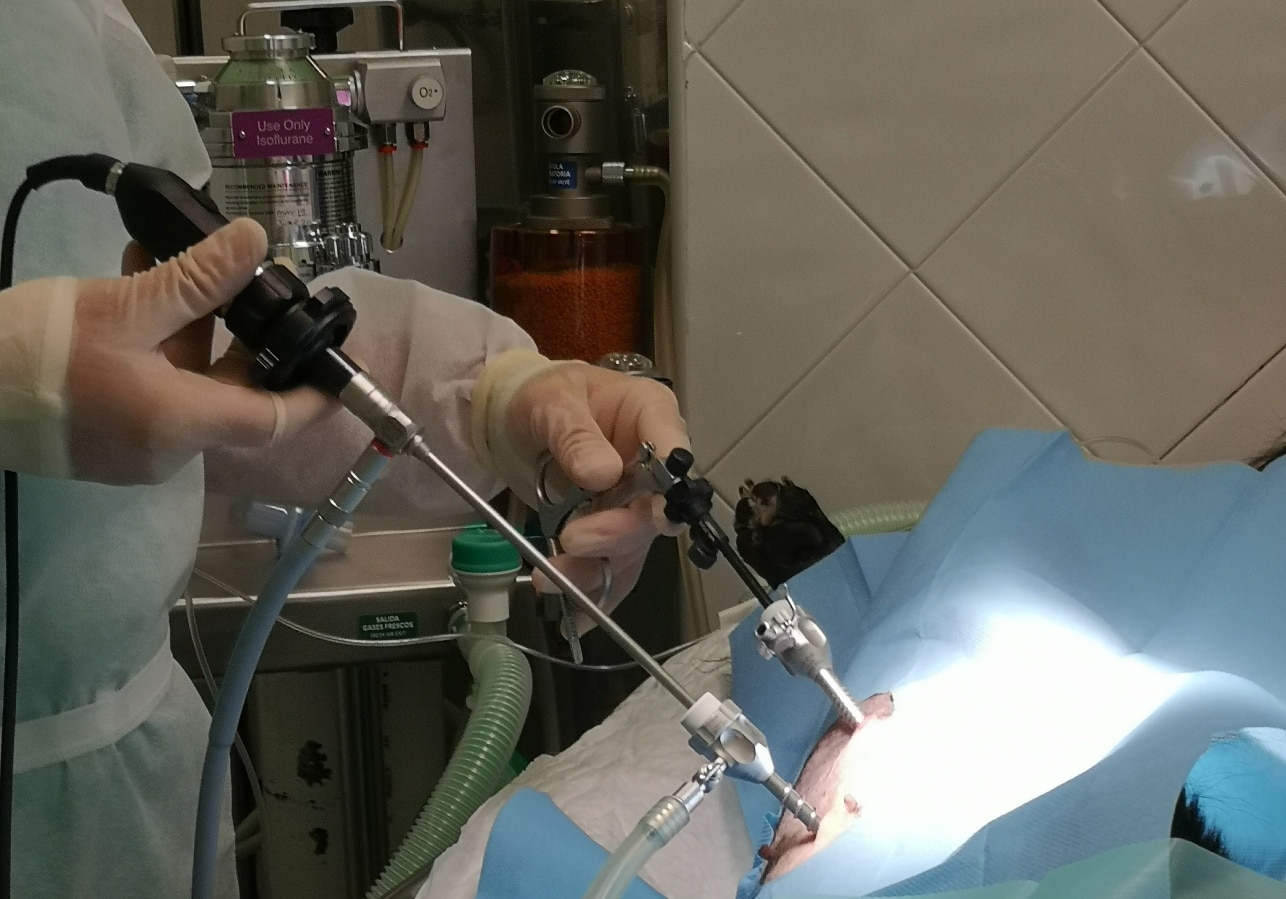
Dogs undergoing minimally invasive surgeries involving carbon dioxide (CO₂) pneumoperitoneum, used to promote abdominal cavity distension, may develop hemodynamic and respiratory alterations resulting from CO₂ retention and increased intra-abdominal pressure. These changes may impair diaphragmatic movement, compromising gas exchange and leading to hypoxemia and hypercapnia. In this context, the present study addressed the importance of ventilatory management through a literature review and prospective clinical follow-up of four dogs undergoing cholecystectomy and/or liver biopsy by video-laparoscopic surgery.The patients were anesthetized using individualized protocols and ventilated with different strategies, including spontaneous/assisted ventilation, volume-controlled ventilation (VCV), and synchronized intermittent mandatory ventilation (SIMV). In all cases, the monitored physiological parameters remained stable throughout the procedure. Episodes of bradycardia associated with opioid administration and abdominal insufflation were observed; however, both were self-limiting and did not require intervention. In the cases evaluated, different ventilatory modalities proved to be feasible when combined with appropriate monitoring, contributing to greater anesthetic stability during videolaparoscopic procedures.
References
Ainsworth, D. M., & Biller, D. S. (2000). Sistema respiratório. In S. M. Reed & V. M. Bayly (Eds.), Medicina interna equina (pp. 229–230). Guanabara Koogan S.A.
Anderson, S. J., & Fransson, B. A. (2019). Complications related to entry techniques for laparoscopy in 159 dogs and cats. Veterinary Surgery, 48(5), 707–714. https://doi.org/10.1111/vsu.13230.
Campbell, K. L., & Davis, C. A. (1990). Effects of thyroid hormones on serum and cutaneous fatty acid concentrations in dogs. American Journal of Veterinary Research, 51(5), 752–756. https://doi.org/10.1016/0034-5288(92)90106-C.
Carmo, J. P., Barbosa, S. N., Andrade, G. S., Duarte, R. V. S., Silva, A. T. R., Santos, F. S., Silva, L. S., & Sousa Júnior, P. F. (2026). Desafios na estabilização do pneumotórax aberto: Ventilação mecânica em cão com trauma torácico. PUBVET, 20(2), 1–6. https://doi.org/10.31533/pubvet.v20n2e1908.
Crispi, C. O., Oliveira, F. M. M., Júnior, J. C. D., Oliveira, M. A. P., & Ribeiro, P. A. G. (2014). Tratado de endoscopia ginecológica: Cirurgia minimamente invasiva (1st ed., Vol. 1). Revinter.
Cunningham, J. (2011). Tratado de fisiologia veterinária. Guanabara Koogan.
Dukes, H. H. (1978). Fisiologia de los animais domesticos. Aquilar.
Fantoni, D. T., & Cortopassi, S. R. G. (2009). Anestesia em cães e gatos (402 p.). Roca.
Fantoni, D. T., & Gimenes, A. M. (2023). Edema pulmonar cardiogênico e não cardiogênico. In M. M. Jericó, D. T. Fantoni, & C. B. Bell (Eds.), Ventilação mecânica em medicina veterinária (Vol. 1, pp. 287–300). Manole.
Fantoni, D. T., Ida, K. K., Lopes, T. F. T., Otsuki, D. A., Auler, J. O. C., & Ambrósio, A. M. (2016). A comparison of the cardiopulmonary effects of pressure-controlled ventilation and volume controlled ventilation in healthy anesthetized dogs. Journal of Veterinary Emergency and Critical Care (San Antonio, Tex. : 2001), 26(4), 1–7. https://doi.org/10.1111/vec.12485.
Gautam, B., Maharjan, A., & Ghimire, S. (2020). Bradycardia during laparoscopic surgeries: A cross-sectional study. Journal of Kathmandu Medical College, 9(1). https://doi.org/10.3126/jkmc.v9i1.33515.
Grimm, K. A. (2017). Anestesiologia e Analgesia em Veterinária. In Lumb & Jones (Ed.), Anestesiologia e Analgesia em Veterinária (Number 9). Roca, São Paulo.
Güldner, A., Kiss, T., Serpa Neto, A., Hemmes, S. N. T., Canet, J., Spieth, P. M., Rocco, P. R. M., Schultz, M. J., Pelosi, P., & Gama De Abreu, M. (2015). Intraoperative protective mechanical ventilation for prevention of postoperative pulmonary complications: A comprehensive review of the role of tidal volume, positive end-expiratory pressure, and lung recruitment maneuvers. Anesthesiology, 123(3), 692–713. https://doi.org/10.1097/ALN.0000000000000754.
Guyton, A. C., & Hall, J. E. (2021). Tratado de fisiologia médica (1067). Elsevier Brasil.
Guzel, O., Yildar, E., Karabagli, G., Erdikmen, D. O., & Ekici, A. (2013). Comparison of the effects of spontaneous and mechanical ventilation on blood gases during general anaesthesia in dogs. Kafkas Universitesi Veteriner Fakultesi Dergisi, 19(SUPPL.A), A19–A25. https://doi.org/10.9775/kvfd.2012.7489.
Hao, L. M., Li, X., Shi, Y., Cai, M. L., Ren, S., Xie, F., Li, Y. N., Wang, N., Wang, Y. X., Luo, Z. J., & Xu, M. (2021). Mechanical ventilation strategy for pulmonary rehabilitation based on patient-ventilator interaction. Science China Technological Sciences, 64(4). https://doi.org/10.1007/s11431-020-1778-8.
Heyba, M., Khalil, A., & Elkenany, Y. (2020). Severe Intraoperative Bradycardia during Laparoscopic Cholecystectomy due to Rapid Peritoneal Insufflation. Case Reports in Anesthesiology, 2020. https://doi.org/10.1155/2020/8828914.
Hopper, K., & Powell, L. L. (2013). Noções básicas de ventilação mecânica para cães e gatos. Veterinary Clinics of North America - Small Animal Practice, 43(4), 955–969.
Inoue, A. Y., & Castro, A. G. M. (2009). Fisiopatologia do sistema respiratório. In J. A. Berchieri, E. N. Silva, J. Di Fabio, L. Sesti, & M. A. F. Zuanaze (Eds.), Doença das aves. Facta.
Jung, K. T., Kim, S. H., Kim, J. W., & So, K. Y. (2013). Bradycardia during laparoscopic surgery due to high flow rate of CO2 insufflation. Korean Journal of Anesthesiology, 65(3), 276–277. https://doi.org/10.4097/kjae.2013.65.3.276.
Keszler, M. (2017). Mechanical ventilation strategies. Seminars in Fetal and Neonatal Medicine, 22(4). https://doi.org/10.1016/j.siny.2017.06.003.
Kim, D., Seo, M., Choi, G., Lee, S. K., Lee, S., Lee, W. J., Yun, S. H., Kwon, Y. S., & Jang, M. (2023). Cardiovascular and Respiratory Effects of Increased Intra-Abdominal Pressure with and without Dexmedetomidine in Anesthetized Dogs. Veterinary Sciences, 10(11), 634. https://doi.org/10.3390/vetsci10110634.
Lewith, H., & Pandit, J. J. (2023). Lung ventilation and the physiology of breathing. Surgery - Oxford International Edition, 41(3). https://doi.org/10.1016/j.mpsur.2023.01.007.
Machado, F. D., Eder, G. L., Dullius, C. R., & Baldisserotto, S. (2014). Ventilação Mecânica: Como Iniciar. Biblioteca Virtual Em Saúde MS, (35), 1–8.
Melo, D. P., Aleixo, G. A. S., & Coelho, M. C. O. C. (2010). Laparoscopia em cães e gatos: Revisão de literatura. Medicina Veterinaria, 4(1), 22–26.
Milovancev, M., & Townsend, K. L. (2015). Current Concepts in Minimally Invasive Surgery of the Abdomen. Veterinary Clinics of North America - Small Animal Practice, 45(3), 507–522. https://doi.org/10.1016/j.cvsm.2015.01.004.
Sawant, U., Sen, J., & Madavi, S. (2024). Pressure Control Ventilation Versus Volume Control Ventilation in Laparoscopic Surgery: A Narrative Review. Cureus, e66916. https://doi.org/10.7759/cureus.66916.
Schultz, M. J., Abreu, G., & Pelosi, P. (2015). Mechanical ventilation strategies for the surgical patient. Current Opinion in Critical Care, 21(4), 351–357.
Souza-Fabjan, J. M. G., Pereira, A. F., Melo, C. H. S., Sanchez, D. J. D., Oba, E., Mermillod, P., Melo, L. M., Teixeira, D. I. A., & Freitas, V. J. F. (2013). Assessment of the reproductive parameters, laparoscopic oocyte recovery and the first embryos produced in vitro from endangered Canindé goats (Capra hircus). Reproductive Biology, 13(4), 325–332. https://doi.org/http://dx.doi.org/10.1016/j.repbio.2013.09.005.
Downloads
Published
Issue
Section
License
Copyright (c) 2026 Thais Rocha Silva, Rita de Cássia Anaya Gutierrez, André Preturlon Terra, Ivan Luis Pinto Sampaio, Shellen Chen Lopes, Edilberto de Oliveira Rodrigues, Tatiane Marquini Ribeiro, Tabata Larissa Dalmagro, Patricia Franciscone Mendes

This work is licensed under a Creative Commons Attribution 4.0 International License.
Você tem o direito de:
Compartilhar — copiar e redistribuir o material em qualquer suporte ou formato
Adaptar — remixar, transformar, e criar a partir do material para qualquer fim, mesmo que comercial.
O licenciante não pode revogar estes direitos desde que você respeite os termos da licença. De acordo com os termos seguintes:
Atribuição
— Você deve dar o crédito apropriado, prover um link para a licença e indicar se mudanças foram feitas. Você deve fazê-lo em qualquer circunstância razoável, mas de nenhuma maneira que sugira que o licenciante apoia você ou o seu uso. Sem restrições adicionais
— Você não pode aplicar termos jurídicos ou medidas de caráter tecnológico que restrinjam legalmente outros de fazerem algo que a licença permita.