Occurrence and antimicrobial resistance profile of bacterial isolates from urine cultures of dogs treated at a university veterinary hospital
DOI:
https://doi.org/10.31533/pubvet.v20n6e1961Keywords:
dogs, multidrug resistance, urine cultureAbstract
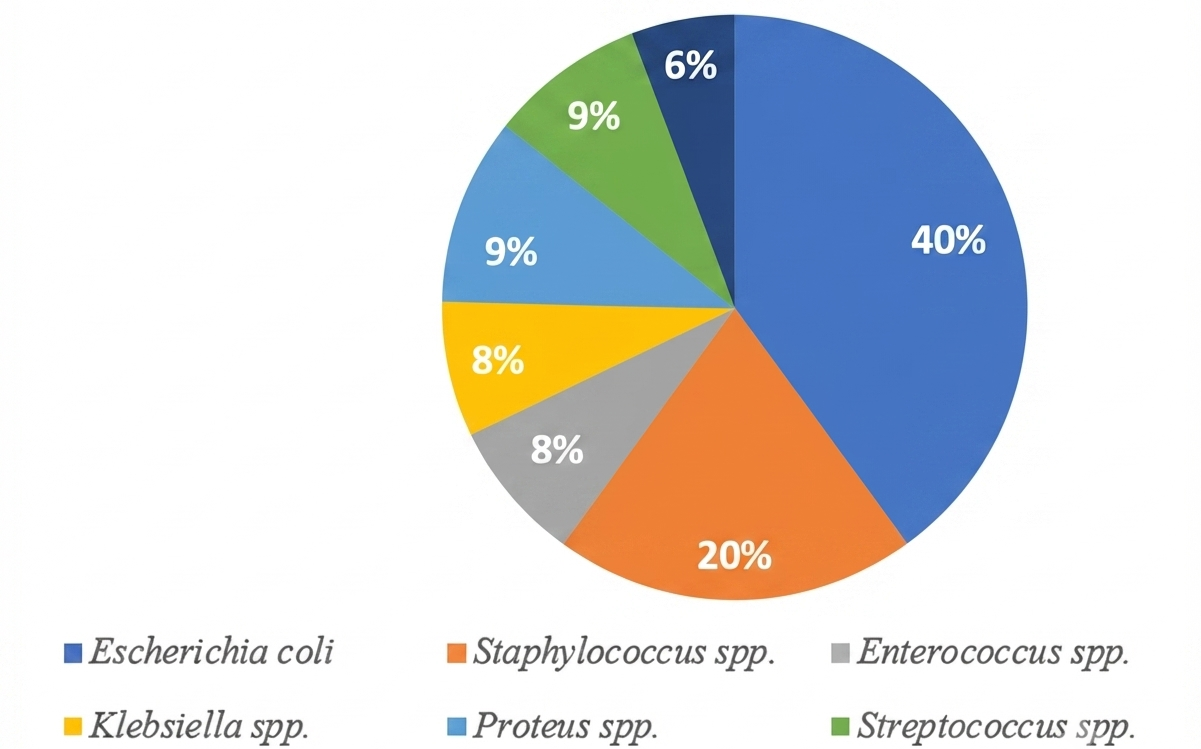
Antimicrobial resistance represents a major challenge in veterinary medicine, particularly in the management of urinary tract infections (UTIs) in dogs, which are among the leading causes of antimicrobial prescriptions in small animal practice. This study aimed to evaluate the occurrence and antimicrobial resistance profile of bacterial isolates recovered from urine samples of dogs treated at the Veterinary Hospital of Unesp – Jaboticabal. A cross-sectional observational study was conducted using convenience samples, based on the analysis of microbiological culture and antimicrobial susceptibility testing (AST) results from samples collected between January 6 and November 30, 2025. Thirty-one positive urine samples were analyzed, yielding a total of 35 bacterial isolates. Gram-negative bacteria predominated among the isolates, with Escherichia coli being the most frequently identified species. Overall, 42.9% of the isolates exhibited resistance to at least one antimicrobial agent, whereas 15.8% were classified as multidrug-resistant. In conclusion, although most isolates showed a favorable susceptibility profile, the detection of resistant microorganisms highlights the need for prudent antimicrobial use and routine antimicrobial susceptibility testing to support the appropriate management of canine urinary tract infections.
References
Allison, S. D., & Martiny, J. B. H. (2008). Resistance, resilience, and redundancy in microbial communities. Proceedings of the National Academy of Sciences, 105(Supp1), 11512–11519. https://doi.org/10.17226/12501.
Bartges, J. W. (2004). Diagnosis of urinary tract infections. Veterinary Clinics of North America: Small Animal Practice, 34, 923-933. Doi http://dx.doi.org/10.1016/j.cvsm.2004.03.001.
Bermudez, T., Schmitz, J. E., Boswell, M., & Humphries, R. (2025). Novel technologies for the diagnosis of urinary tract infections. Journal of Clinical Microbiology, 63(2). https://doi.org/10.1128/jcm.00306-24.
Blair, J. M. A., Webber, M. A., Baylay, A. J., Ogbolu, D. O., & Piddock, L. J. V. (2015). Molecular mechanisms of antibiotic resistance. Nature Reviews Microbiology, 13(1), 42–51. https://doi.org/10.1038/nrmicro3380.
BRASIL. Agência Nacional de Vigilância Sanitária – Anvisa. (2020). Módulo 4 – Procedimentos laboratoriais: da requisição do exame à análise microbiológica e laudo final. Anvisa, Brasília, DF, Brasil.
Byron, J. K. (2017). Drugs used to manage urinary incontinence in dogs and cats. In Plumb’s Therapeutics Brief (pp. 53–58).
Byron, J. K. (2019). Urinary tract infection. Veterinary Clinics: Small Animal Practice, 49(2), 211–221. https://doi.org/10.1016/j.cvsm.2018.11.005.
CLSI. (2016). Clinical and laboratory standards institute. In C. and L. S. Institute (Ed.), Performance standards for antimicrobial susceptibility testing; twenty-four informational supplements.
Collignon, P. J., & McEwen, S. A. (2019). One health—its importance in helping to better control antimicrobial resistance. Tropical Medicine and Infectious Disease, 4(1), 22. https://doi.org/10.3390/tropicalmed4010022.
Damborg, P., Pirolo, M., Schøn Poulsen, L., Frimodt-Møller, N., & Guardabassi, L. (2023). Dogs Can Be Reservoirs of Escherichia coli Strains Causing Urinary Tract Infection in Human Household Contacts. Antibiotics, 12(8). https://doi.org/10.3390/antibiotics12081269
Economou, V., & Gousia, P. (2015). Agriculture and food animals as a source of antimicrobial-resistant bacteria. Infection and Drug Resistance, 8, 49. https://doi.org/10.2147/IDR.S55778.
EUCAST. (2025). Breakpoint tables for interpretation of MICs and zone diameters (Vol. 1, Number 1). Växjo.
Guardabassi, L., Schwarz, S., & Lloyd, D. H. (2004). Pet animals as reservoirs of antimicrobial-resistant bacteria. In Journal of Antimicrobial Chemotherapy (Vol. 54, Number 2, pp. 321–332). https://doi.org/10.1093/jac/dkh332.
Hecht, S. (2015). Diagnostic imaging of lower urinary tract disease. In Veterinary Clinics of North America - Small Animal Practice (Vol. 45, Number 4, pp. 639–663). https://doi.org/10.1016/j.cvsm.2015.02.002.
Ishikura, J. I., Cordeiro, C. T., Silva, E. C., Bueno, G. P., Santos, L. G., & Oliveira, S. T. (2017). Mini-hospital veterinário: guarda responsável, bem estar animal, zoonoses e proteção à fauna exótica. Revista Brasileira de Extensão Universitária, 8(1), 23–30. https://doi.org/10.24317/2358-0399.2017v8i1.3123
Kahn, L. H. (2017). Perspective: The one-health way. Nature, 543(7647), S47–S47.
Kim, D.-W., & Cha, C.-J. (2021). Antibiotic resistome from the One-Health perspective: understanding and controlling antimicrobial resistance transmission. Experimental & Molecular Medicine, 53(3), 301–309. https://doi.org/10.1038/s12276-021-00569-z.
Kogika, M. M., & Waki, M. F. (2015). Infecção do trato urinário de cães. In M. M. Jericó, J. P. Andrade Neto, & M. M. Kogika (Eds.), Tratado de Medicina Interna de Cães e Gatos (Vol. 1, pp. 443–446). Guanabara, Koogan.
Lang, J. (2006). Urinary tract. In P. Mannion (Ed.), Diagnostic ultrasound in small animal practice. Blackwell Publishing.
Magiorakos, A. P., Srinivasan, A., Carey, R. B., Carmeli, Y., Falagas, M. E., Giske, C. G., Harbarth, S., Hindler, J. F., Kahlmeter, G., Olsson-Liljequist, B., Paterson, D. L., Rice, L. B., Stelling, J., Struelens, M. J., Vatopoulos, A., Weber, J. T., & Monnet, D. L. (2012). Multidrug-resistant, extensively drug-resistant and pandrug-resistant bacteria: An international expert proposal for interim standard definitions for acquired resistance. Clinical Microbiology and Infection, 18(3), 268–281. https://doi.org/10.1111/j.1469-0691.2011.03570.x.
McEwen, S. A., & Collignon, P. J. (2018). Antimicrobial resistance: a one health perspective. Microbiology Spectrum, 6(2), 2–6. https://doi.org/10.1093/trstmh/trx050.
Menezes, M. P., Borzi, M. M., Ruaro, M. A., Cardozo, M. V., Rabelo, R. C., Verbisck, N. V., & Moraes, P. C. (2022). Multidrug-Resistant Bacteria Isolated from Surgical Site of Dogs, Surgeon’s Hands and Operating Room in a Veterinary Teaching Hospital in Brazil. Topics in Companion Animal Medicine, 49, 100638. https://doi.org/10.1016/j.tcam.2022.100638.
Menezes, M. P., Facin, A. C., Cardozo, M. V., Costa, M. T., & Moraes, P. C. (2021). Evaluation of the Resistance Profile of Bacteria Obtained from Infected Sites of Dogs in a Veterinary Teaching Hospital in Brazil: A Retrospective Study. Topics in Companion Animal Medicine, 42, 100489. https://doi.org/10.1016/j.tcam.2020.100489.
Morley, P. S., Apley, M. D., Besser, T. E., Burney, D. P., Fedorka-Cray, P. J., Papich, M. G., Traub-Dargatz, J. L., & Weese, J. S. (2005). ACVIM Consensus Statement - Antimicrobial Drug Use in Veterinary Medicine. Journal of Veterinary Internal Medicine, (19).
Munita, J. M., & Arias, C. A. (2016). Mechanisms of antibiotic resistance. Frontiers in Microbiology, 4(2), 481–511. https://doi.org/http://dx.doi.org/10.3389/fmicb.2015.00034.
Nelson, R., & Couto, C. G. (2015). Medicina interna de pequenos animais (3.ed.). Elsevier Brasil.
Olin, S. J., & Bartges, J. W. (2015). Urinary tract infections: treatment/comparative therapeutics. Veterinary Clinics: Small Animal Practice, 45(4), 721–746. https://doi.org/10.1016/j.cvsm.2015.02.005.
O’Neill, J. (2016). Review on Antimicrobial Resistance. Tackling Drug-Resistant Infections Globally. Revue de Laryngologie - Otologie - Rhinologie.
Raji, M. I. O., & Bello, S. A. (2024). Mechanisms of Antibiotic Resistance in Bacteria: A Review. African Journal of Pharmaceutical Sciences, 4(1), 1–12. https://doi.org/10.51483/afjps.4.1.2024.1-12.
Santos, L. R., Scalco Neto, J. F., Rizzo, N. N., Bastiani, P. V., Rodrigues, L. B., Barcellos, H. H. A., & Brun, M. V. (2010). Contaminação ambiental em um hospital veterinário e perfil de susceptibilidade a antimicrobianas das bactérias isoladas. Ciência Animal Brasileira, 11(2), 384–389. https://doi.org/10.5216/cab.v11i2.2988.
Scherk, M. (2008). Urinary tract disorders: The upper urinary tract. In S. E. Little (Ed.), The cat: clinical medicine and management (pp. 935–980). Elsevier Saunders.
Thompson, M. F., Litster, A. L., Platell, J. L., & Trott, D. J. (2011). Canine bacterial urinary tract infections: new developments in old pathogens. The Veterinary Journal, 190(1), 22–27.
Von Wintersdorff, C. J. H., Penders, J., Van Niekerk, J. M., Mills, N. D., Majumder, S., Van Alphen, L. B., Savelkoul, P. H. M., & Wolffs, P. F. G. (2016). Dissemination of antimicrobial resistance in microbial ecosystems through horizontal gene transfer. Frontiers in Microbiology, 7, 173. https://doi.org/10.3389/fmicb.2016.00173.
Weese, J. S., Blondeau, J., Boothe, D., Guardabassi, L. G., Gumley, N., Papich, M., Jessen, L. R., Lappin, M., Rankin, S., & Westropp, J. L. (2019). International Society for Companion Animal Infectious Diseases (ISCAID) guidelines for the diagnosis and management of bacterial urinary tract infections in dogs and cats. The Veterinary Journal, 247, 8–25. https://doi.org/10.1016/j.tvjl.2019.02.008.
Weese, J. S., Giguère, S., Guardabassi, L., Morley, P. S., Papich, M., Ricciuto, D. R., & Sykes, J. E. (2015). ACVIM Consensus Statement on Therapeutic Antimicrobial Use in Animals and Antimicrobial Resistance. Journal of Veterinary Internal Medicine, 29(2), 487–498. https://doi.org/10.1111/jvim.12562.
WHO. (2022). Global antimicrobial resistance and use surveillance system (GLASS) report 2022. World Health Organization, 1(1).
Wright, G. D. (2011). Molecular mechanisms of antibiotic resistance. Chemical Communications, 47(14). https://doi.org/10.1039/c0cc05111j.
Downloads
Published
Issue
Section
License
Copyright (c) 2026 Murilo Henrique Dias da Silva, Giulia Vasquez Chiarato dos Santos, Maria Eduarda de Souza Oliveira, Thais Isaias dos Santos, Paola Castro Moraes, Mareliza Possa de Menezes

This work is licensed under a Creative Commons Attribution 4.0 International License.
Você tem o direito de:
Compartilhar — copiar e redistribuir o material em qualquer suporte ou formato
Adaptar — remixar, transformar, e criar a partir do material para qualquer fim, mesmo que comercial.
O licenciante não pode revogar estes direitos desde que você respeite os termos da licença. De acordo com os termos seguintes:
Atribuição
— Você deve dar o crédito apropriado, prover um link para a licença e indicar se mudanças foram feitas. Você deve fazê-lo em qualquer circunstância razoável, mas de nenhuma maneira que sugira que o licenciante apoia você ou o seu uso. Sem restrições adicionais
— Você não pode aplicar termos jurídicos ou medidas de caráter tecnológico que restrinjam legalmente outros de fazerem algo que a licença permita.