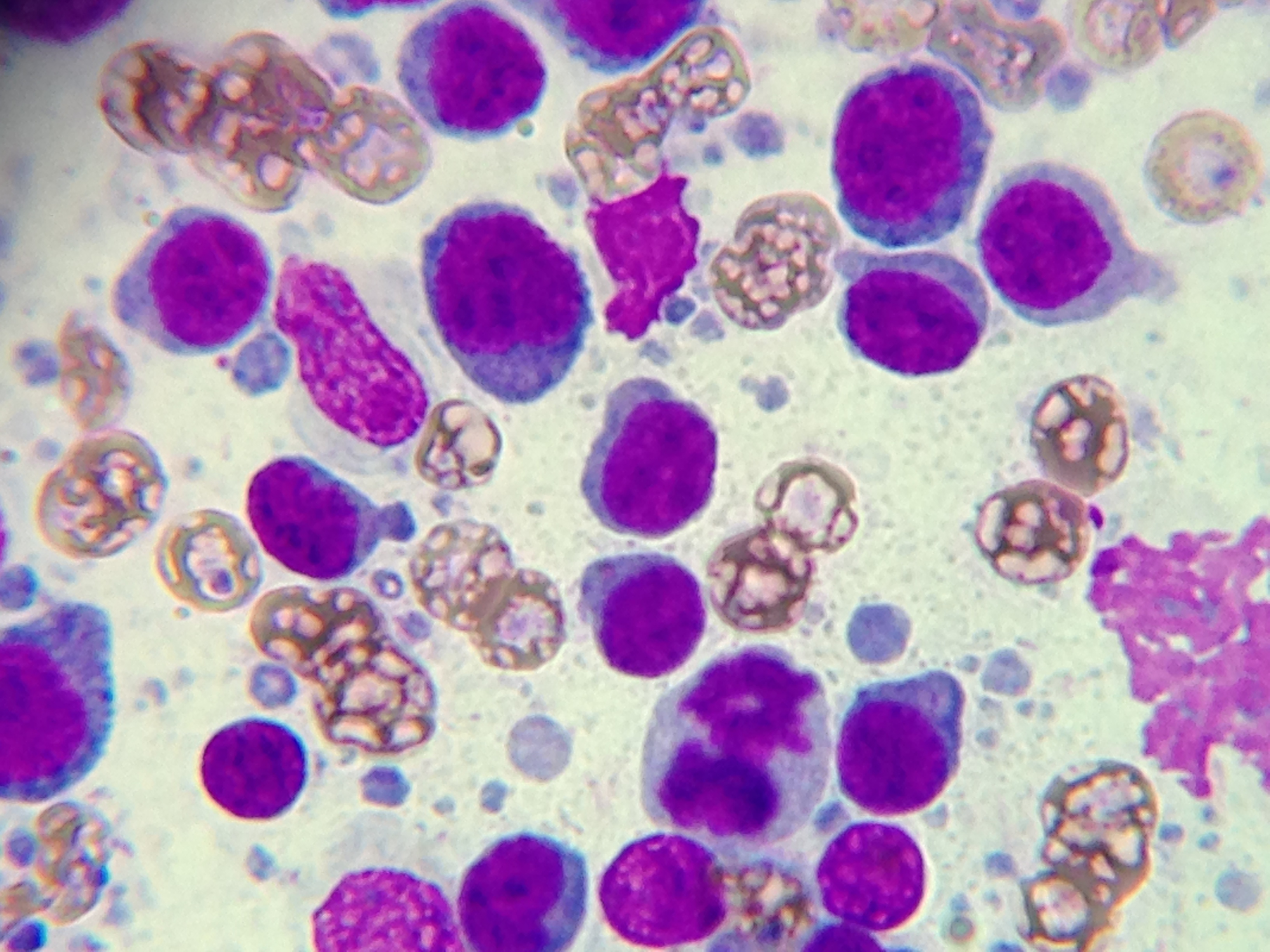
Canine multicentric lymphoma: Diagnosis, staging, treatment, and prognosis
DOI:
https://doi.org/10.31533/pubvet.v20n4e1938Keywords:
Dogs, hematopoietic neoplasms, veterinary oncology, chemotherapyAbstract
The aim of this study was to address the main diagnostic methods, staging and substaging criteria, as well as the therapeutic options and prognosis of canine multicentric lymphoma (CML). CML is one of the most common hematopoietic neoplasms in dogs, accounting for approximately 7–24% of all canine neoplasms and about 85% of hematopoietic malignancies. It is a lymphoid-origin disorder characterized by the uncontrolled proliferation of lymphocytes at different stages of differentiation, with a multifactorial etiology involving genetic predisposition, environmental factors, and immunosuppression. Classification is based on clinical, histological, and immunophenotypic criteria, with the multicentric form being the most common clinical presentation. Diagnosis involves the association of clinical, cytopathological, histopathological, and molecular biology examinations. Staging assesses the extent of the disease, whereas substaging considers the presence or absence of systemic clinical signs. Polychemotherapy, especially the 19-week CHOP protocol, constitutes the treatment of first choice. In conclusion, canine multicentric lymphoma requires accurate diagnosis and an individualized therapeutic approach aimed at maximizing survival and maintaining patients’ quality of life.
References
Alonso, V., & Alvarado, B. (2020). Linfoma multicéntrico canino: caso clínico. Culcyt Veterinaria, (50).
Bennett, P., Williamson, P., & Taylor, R. (2023). Review of Canine Lymphoma Treated with Chemotherapy—Outcomes and Prognostic Factors. Veterinary Sciences, 10(5), 293. https://doi.org/10.3390/vetsci10050342.
Beraldo, M. R. A., Varzim, F. L. S. B., & Pulz, L. H. (2020). Linfoma multicêntrico canino: Uma sinopse sobre os aspectos clinicopatológicos e alterações laboratoriais. Revista de Educação Continuada em Medicina Veterinária e Zootecnia do CRMV-SP, 18(2). https://doi.org/10.36440/recmvz.v18i3.38066.
Boes, K. M., & Durham, A. C. (2017). Bone Marrow, Blood Cells, and the Lymphoid/Lymphatic System. In Pathologic Basis of Veterinary Disease Expert Consult (Vol. 10, p. 293). https://doi.org/10.1016/B978-0-323-35775-3.00013-8.
Cápua, M. L. B., Coleta, F. E. Dela, Canesin, A. P. M. N., Godoy, A. V., Calazans, S. G., Miotto, M. R., Daleck, C. R., & Santana, A. E. (2011). Linfoma canino: Clínica, hematologia e tratamento com o protocolo de Madison-Wisconsin. Ciência Rural, 41(7), 1245–1251. https://doi.org/10.1590/S0103-84782011005000090.
Cardoso, M. J. L., Machado, L. H. A., Moutinho, F. Q., & Padovani, C. R. (2004). Linfoma canino: Achados clínico - patológicos. Archives of Veterinary Science, 9(2), 25–29. https://doi.org/10.5380/avs.v9i2.4060.
Couto, C. G. (2000). Advances in the treatment of the cat with lymphoma in practice. Journal of Feline Medicine and Surgery, 2(2), 95–100.
Couto, C. G. (2015). Oncologia. In R. G. Nelson & C. G. Couto (Eds.), Medicina interna de pequenos animais (pp. 1105–1107). Elsevier Saunders.
Craig, K. K. L., Wood, G. A., Keller, S. M., Mutsaers, A. J., & Wood, R. D. (2019). MicroRNA profiling in canine multicentric lymphoma. PLoS ONE, 14(12), e0226357. https://doi.org/10.1371/journal.pone.0226357.
Elmore, S. A. (2006). Enhanced Histopathology of the Lymph Nodes. Toxicologic Pathology, 34(5). https://doi.org/10.1080/01926230600939997.
Ferreira, M. G. P. A., & De Nardi, A. B. (2021). Manual prático de quimioterapia antineoplásica em cães e gatos (1st ed., Vol. 1). MedVet Livros.
Ludwig, L., Treleaven, H., Moorehead, R., Foster, R. A., Wood, R. D., Ali, R. A., & Wood, G. A. (2025). Classification and Prognostication of B-Cell and T-Cell Multicentric Lymphoma in Dogs Using Serum MicroRNAs. Veterinary and Comparative Oncology, 23(2). https://doi.org/10.1111/vco.13057.
Mazaro, R. D., Rizkallah, I. P. J., Luz, F. S., Lorensetti, D. M., Cogliati, B., & Fighera, R. A. (2018). Aspectos epidemiológicos, clínicos e anatomopatológicos do linfoma folicular em cães. Pesquisa Veterinária Brasileira, 38(9). https://doi.org/10.1590/1678-5150-pvb-5286.
Moore, A. S. (2016). Treatment of T cell lymphoma in dogs. Veterinary Record, 179(11). https://doi.org/10.1136/vr.103456.
Nelson, R. W.; Couto, C. G. (2019). Small animal internal medicine. 6. ed. St. Louis: Elsevier.
O’Connor, C. M., & Wilson-Robles, H. (2014). Developing T cell cancer immunotherapy in the dog with lymphoma. ILAR Journal, 55(1), 169–181. https://doi.org/10.1093/ilar/ilu020.
Owen, L. N. (1980). TNM Classification of tumours in domestic animals. World Health Organization.
Poche, A., Agudelo, A., Sanchez, D., & Valencia, A. (2017). Aproximación diagnóstica a un linfoma multicentrico en canino. Revista Electrónica de Veterinaria, 18(11).
Pokhrel, S. (2024). Linfoma multicêntrico canino: Revisão de literatura. In Repositório Universidade Federal do Rio Grande Dd Sul (Vol. 15, Number 1).
Rassnick, K. M., Mauldin, G. E., Al-Sarraf, R., Mauldin, G. N., Moore, A. S., & Mooney, S. C. (2002). MOPP chemotherapy for treatment of resistant lymphoma in dogs: A retrospective study of 117 cases (1989-2000). Journal of Veterinary Internal Medicine, 16(5), 576–580. https://doi.org/10.1111/j.1939-1676.2002.tb02390.x.
Riondato, F. & Comazzi, S. (2021). Flow cytometry in the diagnosis of canine B-cell lymphoma. Frontiers in Veterinary Science, 8, 600986. https://doi.org/10.3389/fvets.2021.600986 2021.
Rocha, M. C. P., Araújo, D., Carvalho, F., Vale, N., Pazzini, J. M., Feliciano, M. A. R., De Nardi, A. B., & Amorim, I. (2025). Canine Multicentric Lymphoma: Diagnostic, Treatment, and Prognostic Insights. Animals, 15(3), 391. https://doi.org/10.3390/ani15030391.
Sánchez, D., Sánchez-Verin, R., Corona, H., Gutiérrez, A., Núñez-Ochoa, L., Paredes, J., & Cesarman-Maus, G. (2019). Canine lymphoma: Pathological and clinical characteristics of patients treated at a referral hospital. Veterinaria Mexico OA, 6(2). https://doi.org/10.22201/fmvz.24486760e.2019.2.495.
Skinner, S. M., Specht, A. J., Cicchirillo, V., Fox-Alvarez, S., & Harris, A. N. (2024). Association of proteinuria at time of diagnosis with survival times in dogs with lymphoma. Journal of Veterinary Internal Medicine, 38(5). https://doi.org/10.1111/jvim.17144.
Thalheim, L., Williams, L. E., Borst, L. B., Fogle, J. E., & Suter, S. E. (2013). Lymphoma immunophenotype of dogs determined by immunohistochemistry, flow cytometry, and polymerase chain reaction for antigen receptor rearrangements. Journal of Veterinary Internal Medicine, 27(6), 1509–1516. https://doi.org/10.1111/jvim.12185.
Vail, D. M., Pinkerton, M. E., & Young, K. M. (2017). Canine Lymphoma and Lymphocytic Leukemias. Journal of Chemical Information and Modeling, 53(9).
Vail, D. M., Thamm, D. H., & Liptak, J. M. (2019). Withrow and MacEwen’s Small Animal Clinical Oncology-E-Book. Elsevier Health Sciences.
Vail, D. M., Pinkerton, M. E., & Young, K. M. (2013). Hematopoietic Tumors — Section A: Canine Lymphoma and Lymphoid Leukemias. In Withrow and MacEwen’s Small Animal Clinical Oncology (5th ed., pp. 608–678). Elsevier Saunders, Philadelphia, PA, USA
Valli, V. E. O. (2013). Histopathologic classification of canine lymphomas and lymphoid leukemias. Veterinary Pathology, 50(1), 1–4.
Waugh, E. M., Gallagher, A., Haining, H., Johnston, P. E. J., Marchesi, F., Jarrett, R. F., & Morris, J. S. (2016). Optimisation and validation of a PCR for antigen receptor rearrangement (PARR) assay to detect clonality in canine lymphoid malignancies. Veterinary Immunology and Immunopathology, 182, 115–124. https://doi.org/10.1016/j.vetimm.2016.10.008.
Withrow, S. J., Page, R., & Vail, D. M. (2020). Small animal clinical oncology. Elsevier Health Sciences. https://doi.org/10.1201/9781315381855.
Zandvliet, M. (2016). Canine lymphoma: a review. Veterinary Quarterly, 36(2), 76–104. https://doi.org/10.1080/01652176.2016.1152633.
Downloads
Published
Issue
Section
License
Copyright (c) 2026 Izabela Da Silveira Martinez, Rafael Costa Bitencourt, Mariana Santos de Miranda

This work is licensed under a Creative Commons Attribution 4.0 International License.
Você tem o direito de:
Compartilhar — copiar e redistribuir o material em qualquer suporte ou formato
Adaptar — remixar, transformar, e criar a partir do material para qualquer fim, mesmo que comercial.
O licenciante não pode revogar estes direitos desde que você respeite os termos da licença. De acordo com os termos seguintes:
Atribuição
— Você deve dar o crédito apropriado, prover um link para a licença e indicar se mudanças foram feitas. Você deve fazê-lo em qualquer circunstância razoável, mas de nenhuma maneira que sugira que o licenciante apoia você ou o seu uso. Sem restrições adicionais
— Você não pode aplicar termos jurídicos ou medidas de caráter tecnológico que restrinjam legalmente outros de fazerem algo que a licença permita.