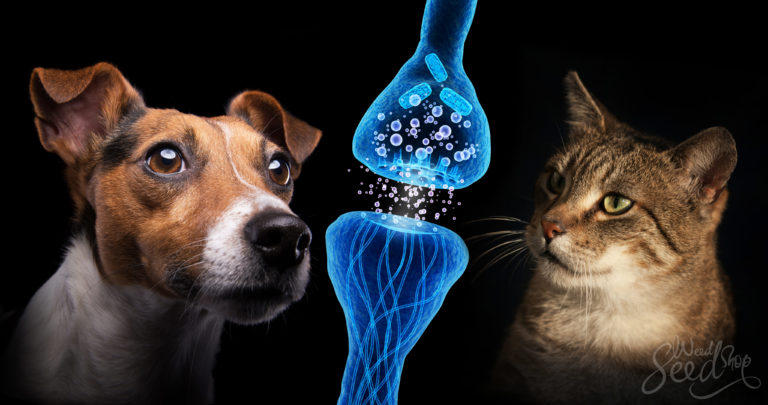
Neurodegenerative biomarkers in dogs and cats
Review
DOI:
https://doi.org/10.31533/pubvet.v20n2e1905Keywords:
beta-amyloid, cognitive dysfunction, GFAP, NfLAbstract
Cognitive Dysfunction Syndrome (CDS) is a progressive neurodegenerative disorder that affects elderly dogs and cats, presenting clinical and neuropathological features similar to those observed in Alzheimer’s disease in humans. It is characterized by behavioral changes related to memory, learning, social interaction, and the sleep–wake cycle, and is often underdiagnosed due to its similarity to normal age-related changes. In this context, neurodegenerative biomarkers have gained increasing interest in veterinary medicine as auxiliary tools for early diagnosis and monitoring of disease progression. The present study aimed to conduct a literature review on the applicability of the main neurodegenerative biomarkers—such as neurofilament light chain (NfL), glial fibrillary acidic protein (GFAP), Tau protein, and beta-amyloid (Aβ)—in the investigation of CDS in dogs and cats. The bibliographic search was carried out in national and international databases, including PubMed, SciELO, ScienceDirect, Google Scholar, Journal of Veterinary Internal Medicine, and BMC Veterinary Research, covering publications from 2015 to 2025. The analyzed studies indicate that NfL stands out as a sensitive marker of axonal damage and age-related neurodegeneration, while GFAP reflects processes of astrogliosis and neuroinflammation. Tau and Aβ proteins show neuropathological relevance, with evidence of cerebral deposition in elderly animals, reinforcing the pathophysiological similarity between CDS and human neurodegenerative diseases. Despite their diagnostic potential, the literature highlights limitations related to biological variability, the lack of standardized reference values, and the need for multicenter validation. It is concluded that the integrated use of these biomarkers, combined with clinical, behavioral, and neurological assessment, represents a promising approach to improve the diagnosis and monitoring of CDS, in addition to contributing to translational medicine.
References
Alsulami, A., Boland, S. W., McGrath, S., MacLean, E. L., Latimer, C. S., Darvas, M., & Moreno, J. A. (2025). Plasma and cerebrospinal fluid biomarkers in aged dogs with cognitive decline. BMC Veterinary Research, 21(1). https://doi.org/10.1186/s12917-025-05027-w.
Bruns, A. I. (2009). Alzheimer’s disease. British Medical Journal, 338, 464–471.
Carneiro, A. A., Hashizume, E. Y., & Elias, B. C. (2017). Epilepsia idiopática em cães. Revista Terra e Cultura, 33(1), 68–83.
Codeceira Júnior, A., Ferreira, M. L. B., Marques, P. R. B., Mesquita, S. D., Vilela, M. L. G., Valença, M. O. S., & Ataíde, L. (1985). Polirradiculoneurites inflamatórias. Neurobiologia, 133–150.
Daponte, A., Koros, C., Skarlis, C., Siozios, D., Rentzos, M., Papageorgiou, S. G., & Anagnostouli, M. (2025). Neurofilament Biomarkers in Neurology: From Neuroinflammation to Neurodegeneration, Bridging Established and Novel Analytical Advances with Clinical Practice. International journal of molecular sciences, 26(19), 9739. https://doi.org/10.3390/ijms26199739
Dias, A. B., & Mendes, P. F. (2023). Síndrome da disfunção cognitiva canina: Alzheimer em cães. PUBVET, 17(9), e1442. https://doi.org/10.31533/pubvet.v17n9e1442.
Ferraz, H. T., Ferreira, M. S., Ferreira, D. R. C., Moreira, C. N., Ávila, A. B. G., Ramos, D. G. S., & Saturnino, K. C. (2025). Síndrome da disfunção cognitiva canina: Revisão. Revista Interação Interdisciplinar (ISSN: 2526-9550), 7(2). https://doi.org/10.35685/qp5r2r32.
Ferroni, L. O., Almeida Júnior, S. T., Moreira, G. S. S., Sousa, P. F., Bíscaro, I. S., & Belato, S. E. (2020). Epilepsia em cães: Aspectos terapêuticos. Brazilian Journal of Development, 6(10), 76485–76501. https://doi.org/10.34117/bjdv6n10-173.
Fiock, K. L., Smith, J. D., Crary, J. F., & Hefti, M. M. (2020). β-amyloid and tau pathology in the aging feline brain. Journal of Comparative Neurology, 528(1). https://doi.org/10.1002/cne.24741.
Flores, F. F. (2016). The Cancer stem cell hypothesis in spontaneous canine gliomas: From tumors to neurogenesis in the adult dog. In TDX (Tesis Doctorals en Xarxa).
Gallego, D., Figueroa, J., & Orozco, C. (2010). Síndrome de disfunción cognitiva de perros geriátrico. Revista MVZ Córdoba, 15(3).
González-Martínez, Á., Rosado, B., García-Belenguer, S., & Suárez, M. (2012). Síndrome de disfunción cognitiva en el perro geriátrico. Clínica Veterinaria de Pequeños Animales, 32(3), 159–167.
Habiba, U., Ozawa, M., Chambers, J. K., Uchida, K., Descallar, J., Nakayama, H., Summers, B. A., Morley, J. W., & Tayebi, M. (2021). Neuronal Deposition of Amyloid-β Oligomers and Hyperphosphorylated Tau Is Closely Connected with Cognitive Dysfunction in Aged Dogs. Journal of Alzheimer’s Disease Reports, 5(1). https://doi.org/10.3233/ADR-210035.
Head, E., Moffat, K., Das, P., Sarsoza, F., Poon, W. W., Landsberg, G., Cotman, C. W., & Murphy, M. P. (2005). β-Amyloid deposition and tau phosphorylation in clinically characterized aged cats. Neurobiology of Aging, 26(5). https://doi.org/10.1016/j.neurobiolaging.2004.06.015.
Heckler, M. C. T., Svicero, D. J., & Amorim, R. M. (2011). Síndrome da disfunção cognitiva em cães. Clínica Veterinária, 90, 70–74.
Heiblum, M., Labastida, R., Gris, G. C., & Tejeda, A. (2007). “Didy,” a clinical case of cognitive dysfunction syndrome. Journal of Veterinary Behavior, 2(3), 68–72. https://doi.org/10.1016/j.jveb.2007.05.002.
Kim, C., Yun, T., Chae, Y., Kim, H., & Kang, B. T. (2025). Diagnostic and Prognostic Value of Serum Neurofilament Light Chain in Canine Spinal Cord Diseases. Veterinary Sciences, 12(10). https://doi.org/10.3390/vetsci12100966.
LaFerla, F. M., Green, K. N., & Oddo, S. (2007). Intracellular amyloid-β in Alzheimer’s disease. Nature Reviews Neuroscience, 8(7), 499–509.
Landsberg, G. M., DePorter, T., & Araujo, J. A. (2011). Clinical signs and management of anxiety, sleeplessness, and cognitive dysfunction in the senior pet. Veterinary Clinics: Small Animal Practice, 41(3), 565–590. https://doi.org/10.1016/j.cvsm.2011.03.017.
Landsberg, G. M., Nichol, J., & Araujo, J. A. (2012). Cognitive dysfunction syndrome: a disease of canine and feline brain aging. Veterinary Clinics: Small Animal Practice, 42(4), 749–768. https://doi.org/10.1016/j.cvsm.2012.04.003.
Laureano, S. A. A. M. (2009). Convulsões e Epilepsia em Cães. In Departamento de Veterinária: Master of Science.
Mietelska-Porowska, A., Wasik, U., Goras, M., Filipek, A., & Niewiadomska, G. (2014). Tau protein modifications and interactions: Their role in function and dysfunction. International Journal of Molecular Sciences, 15(3). https://doi.org/10.3390/ijms15034671.
Milgram, N. W., Head, E., Zicker, S. C., Ikeda-Douglas, C. J., Murphey, H., Muggenburg, B., Siwak, C., Tapp, D., & Cotman, C. W. (2005). Learning ability in aged beagle dogs is preserved by behavioral enrichment and dietary fortification: a two-year longitudinal study. Neurobiology of Aging, 26(1), 77–90. https://doi.org/10.1016/j.neurobiolaging.2004.02.014.
Orsini, H., Bondan, E. F., Sanchez, M., Lallo, M. A., Maiorka, P. C., Dagli, M. L. Z., & Graça, D. L. (2007). Marcação imunoistoquímica da expressão astrocitária de proteína glial fibrilar ácida e de vimentina no sistema nervoso central de cães com cinomose. Arquivos de Neuro-Psiquiatria, 65(4a). https://doi.org/10.1590/s0004-282x2007000600032.
Pereira, R. M. C. (2016). A Síndrome da Disfunção Cognitiva Canina. Universidad de Porto, 2016.
Płonek, M., Wrzosek, M., & Nicpoń, J. (2016). Biomarkers of injury to neural tissue in veterinary medicine. Journal of Veterinary Research (Poland), 60(3). https://doi.org/10.1515/jvetres-2016-0053.
Roerig, A., Carlson, R., Tipold, A., & Stein, V. M. (2013). Cerebrospinal fluid tau protein as a biomarker for severity of spinal cord injury in dogs with intervertebral disc herniation. Veterinary Journal, 197(2). https://doi.org/10.1016/j.tvjl.2013.02.005.
Salvin, H. E., McGreevy P D, Sachedev, P. S., & Valenzuela, M. L. (2010). Development and validation of a canine cognitive dysfunction rating scale. Journal of Veterinary Behavior, 5(5), 306–315. https://doi.org/10.1016/j.jveb.2010.05.001.
Sanabria, C. O., Olea, F., & Rojas, M. (2013). Cognitive dysfunction syndrome in senior dogs. In Neurodegenerative diseases. IntechOpen. https://doi.org/10.5772/54903.
Silva, B. C., Gneiding, B., Lucioli, J., Tesser, J. S., & Gneiding, J. E. B. O. (2018). Síndrome da disfunção cognitiva canina: Revisão de literatura. Revista Acadêmica Ciência Animal, 16. https://doi.org/10.7213/1981-4178.2018.161108.
Sinsky, J., Pichlerova, K., & Hanes, J. (2021). Tau protein interaction partners and their roles in Alzheimer’s disease and other Tauopathies. In International Journal of Molecular Sciences (Vol. 22, Number 17). https://doi.org/10.3390/ijms22179207.
Smolek, T., Madari, A., Farbakova, J., Kandrac, O., Jadhav, S., Cente, M., Brezovakova, V., Novak, M., & Zilka, N. (2016). Tau hyperphosphorylation in synaptosomes and neuroinflammation are associated with canine cognitive impairment. Journal of Comparative Neurology, 524(4). https://doi.org/10.1002/cne.23877.
Sordo, L., Martini, A. C., Houston, E. F., Head, E., & Gunn-Moore, D. (2021). Neuropathology of Aging in Cats and its Similarities to Human Alzheimer’s Disease. Frontiers in Aging, 2. https://doi.org/10.3389/fragi.2021.684607
Sousa, A. V, & Souza, L. F. C. B. (2019). Síndrome da disfunção cognitiva em cães–revisão de literatura. Ciência Veterinária UniFil, Londrina, 1(3), 121–137.
Stylianaki, I., Polizopoulou, Z. S., Theodoridis, A., Koutouzidou, G., Baka, R., & Papaioannou, N. G. (2020). Amyloid-beta plasma and cerebrospinal fluid biomarkers in aged dogs with cognitive dysfunction syndrome. Journal of Veterinary Internal Medicine, 34(4), 784–792. https://doi.org/10.1111/jvim.15812.
Teixeira, P. A. M., Antonio, I. M. S., Mattana, D. L. C., Pina, M. C. S. L., & Peixoto, M. F. N. (2024). Síndrome da disfunção cognitiva canina: Revisão de literatura. Research, Society and Development, 13(11). https://doi.org/10.33448/rsd-v13i11.47446.
Travancinha, J. D. N. P., & Pomba, M. C. M. F. (2015). Alterações comportamentais sugestivas de síndrome da disfunção cognitiva em cães geriátricos. Universidade de Lisboa (Portugal).
Vilanova Júnior, J. A., Dipp, G., Silva Neto, B. P., Balardini, J. L. M., Isaka, L. J. E., Jair, M. S. O. R., & Engracia Filho, R. (2019). Hérnia de disco sequestrada em cão. Acta Scientiae Veterinariae, 47(1), 456.
Wu, C. H., Pan, X. S., Su, L. Y., & Yang, S. Y. (2023). Plasma Neurofilament Light Chains as Blood-Based Biomarkers for Early Diagnosis of Canine Cognitive Dysfunction Syndrome. International Journal of Molecular Sciences, 24(18). https://doi.org/10.3390/ijms241813771.
Downloads
Published
Issue
Section
License
Copyright (c) 2026 Paloma Pires da Silva, Letícia da Silva Tobias

This work is licensed under a Creative Commons Attribution 4.0 International License.
Você tem o direito de:
Compartilhar — copiar e redistribuir o material em qualquer suporte ou formato
Adaptar — remixar, transformar, e criar a partir do material para qualquer fim, mesmo que comercial.
O licenciante não pode revogar estes direitos desde que você respeite os termos da licença. De acordo com os termos seguintes:
Atribuição
— Você deve dar o crédito apropriado, prover um link para a licença e indicar se mudanças foram feitas. Você deve fazê-lo em qualquer circunstância razoável, mas de nenhuma maneira que sugira que o licenciante apoia você ou o seu uso. Sem restrições adicionais
— Você não pode aplicar termos jurídicos ou medidas de caráter tecnológico que restrinjam legalmente outros de fazerem algo que a licença permita.