Bioclimatic assessment of a compost-bedded pack barn system in a highland region during winter
DOI:
https://doi.org/10.31533/10.31533/pubvet.v20n1e1898Keywords:
Animal environment, bioclimatology, thermal comfort, rural constructionAbstract
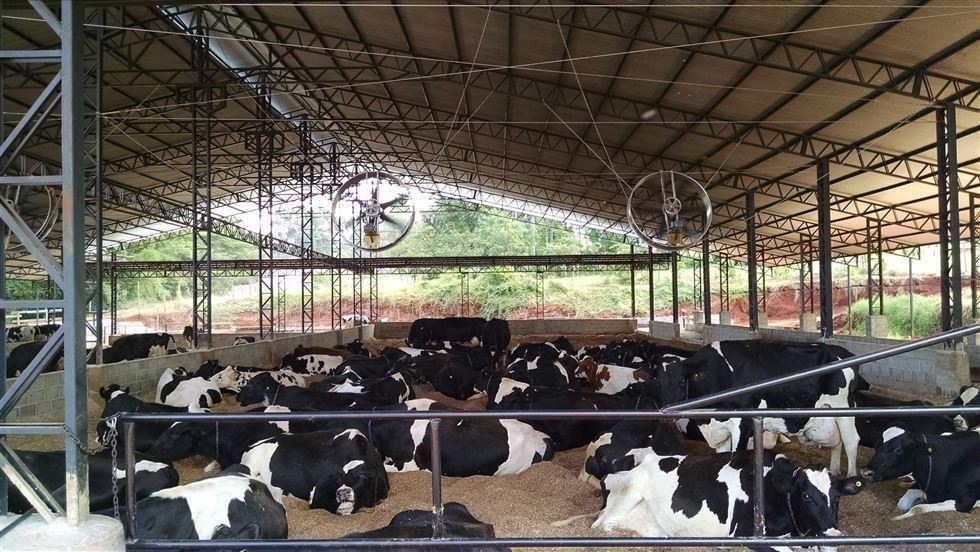
Thermal stress in dairy cattle represents an increasing challenge, even during milder seasons and in high-altitude regions, compromising animal welfare and herd productivity. Confinement systems such as compost-bedded pack barns have been adopted as an alternative to mitigate these effects; however, specific evaluations of their performance are still necessary. In this context, the objective of this study was to evaluate the thermal environment of a compost-bedded pack barn system for dairy cows during the winter season in a highland region. The experiment was conducted during winter in a barn located in the municipality of Diamantina, Minas Gerais, Brazil. Internal and external meteorological variables were monitored, including air temperature, relative humidity, wind speed, black globe temperature, and dry- and wet-bulb temperatures, at three different points inside the barn. Based on these data, the Temperature–Humidity Index (THI), the Black Globe Humidity Index (BGHI), and the Radiant Thermal Load (RTL) were calculated. The results indicated that although the daily mean values of the thermal comfort indices remained within the comfort range for dairy cows, peaks of heat stress occurred at specific times, particularly between 10:00 a.m. and 5:00 p.m., with greater intensity in the central area of the barn. The observed internal thermal heterogeneity highlights the importance of adjustments in management and ventilation strategies. It is concluded that even during winter, environmental control measures are necessary to ensure animal welfare in compost-bedded pack barn systems located in high-altitude regions.
References
Alhussien, M. N., Hussen, J., & Matteis, G. (2024). Editorial: Heat stress and immune responses in livestock: current challenges and intervention strategies. Frontiers in Veterinary Science, 11, 1366274. https://doi.org/10.3389/fvets.2024.1366274.
Allen, J. D., Hall, L. W., Collier, R. J., & Smith, J. F. (2015). Effect of core body temperature, time of day, and climate conditions on behavioral patterns of lactating dairy cows experiencing mild to moderate heat stress. Journal of Dairy Science, 98(1), 118–127. https://doi.org/10.3168/jds.2013-7704.
Atrian, P., & Shahryar, H. A. (2012). Heat stress in dairy cows (a review). Research in Zoology, 2(4), 31–37. https://doi.org/http://dx.doi.org/10.5923/j.zoology.20120204.03.
Baêta, F. C., & Souza, F. C. (2010). Ambiência em edificações rurais: Conforto animal. Universidade Federal de Viçosa.
Barberg, A. E., Endres, M. I., Salfer, J. A., & Reneau, J. K. (2007). Performance and welfare of dairy cows in an alternative housing system in Minnesota. Journal of Dairy Science, 90(3). https://doi.org/10.3168/jds.S0022-0302(07)71643-0.
Bitencourt, D. P., Fuentes, M. V., Maia, P. A., & Amorim, F. T. (2016). Frequência, Duração, Abrangência Espacial e Intensidade de Ondas de Calor no Brasil. Revista Brasileira de Meteorologia, 31(4), 506–517. https://doi.org/10.1590/0102-778631231420150077.
Chen, X., Li, Y., Xiao, J., Dong, J., Zhao, W., Han, Z., Xin, L., Qin, G., Wang, T., Zhen, Y., Sun, Z., & Zhang, X. (2023). Heat stress affects the milk yield, milk composition, serum oxidative status, and metabolites of Holstein cows during mid-lactation. Czech Journal of Animal Science, 68(8), 335–345. https://doi.org/10.17221/2/2023-CJAS.
Buffington, D. E., Collazo-Arocho, A., Canton, G. H., D. Pitt, Thatcher, W. W., & Collier, R. J. (1981). Black Globe-Humidity Index (BGHI) as Comfort Equation for Dairy Cows. Transactions of the ASAE, 24(3), 711–714. https://doi.org/10.13031/2013.34325.
Damasceno, F. A. (2012). Compost bedded pack barns system and computational simulation of airflow through naturally ventilated reduced model. In Curso de Pós-Graduação em Engenharia Agrícola: Vol. PhD.
Eckelkamp, E. A., Taraba, J. L., Akers, K. A., Harmon, R. J., & Bewley, J. M. (2016). Sand bedded freestall and compost bedded pack effects on cow hygiene, locomotion, and mastitis indicators. Livestock Science, 190, 48–57.
Eigenberg, R. A., Brown-Brandl, T. M., & Nienaber, J. A. (2007). Development of a Livestock Weather Safety Monitor for Feedlot Cattle. Applied Engineering in Agriculture, 23(5), 657–660. https://doi.org/10.13031/2013.23666.
Endres, M. I., & Barberg, A. E. (2007). Behavior of dairy cows in an alternative bedded-pack housing system. Journal of Dairy Science, 90(9). https://doi.org/10.3168/jds.2006-751.
Endres, M. I., & Janni, K. A. (2008). Compost bedded pack barns for dairy cows. University of Nebraska-Lincoln, 1, 1–9.
Fávero, S., Portilho, F. V. R., Oliveira, A. C. R., Langoni, H. & Pantoja, J. C. F. (2015). Factors associated with mastitis epidemiologic indexes, animal hygiene, and bulk milk bacterial concentrations in dairy herds housed on compost bedding. Livestock Science, 181. https://doi.org/10.1016/j.livsci.2015.09.002
Ferreira, P. F. S., Araujo, J. E., Pereira, N. A. S., Figueiró, L. S. Do P. & Santo S, L. da C. (2024). Caracterização da direção predominante e velocidade do vento em Diamantina/MG. Contribuciones A las Ciencias Sociales, 17(3), e5474, https://doi.org/10.55905/revconv.17n.3-301.
Freu, G., Garcia, B. L. N., Tomazi, T., Di Leo, G. S., Gheller, L. S., Bronzo, V., Moroni, P., & Santos, M. V. (2023). Association between Mastitis Occurrence in Dairy Cows and Bedding Characteristics of Compost-Bedded Pack Barns. Pathogens, 12(4), 583. https://doi.org/10.3390/pathogens12040583.
Frigeri, K. D. M., Kachinski, K. D., Ghisi, N. C., Deniz, M., Damasceno, F. A., Barbari, M., Herbut, P., & Vieira, F. M. C. (2023). Effects of Heat Stress in Dairy Cows Raised in the Confined System: A Scientometric Review. Animals, 13(3), 350. https://doi.org/10.3390/ani13030350.
Guesine, G. D., Silveira, R. M. F., & Silva, I. J. O. (2023). Physical and environmental characteristics of the compost barn system and its effects on the physical integrity, reproduction and milk production of dairy cattle: a scoping review. Journal of Animal Behaviour and Biometeorology, 11(2), 1–6. https://doi.org/10.31893/JABB.23010.
Janni, K. A., Endres, M. I., Reneau, J. K., & Schoper, W. W. (2007). Compost dairy barn layout and management recommendations. Applied Engineering in Agriculture, 23(1), 97–102.
Kelly, C. F., Bond, T. E., & Itnner, N. R. (1950). Thermal design of livestock shades. Agricultural Engineering, 30, 601–606.
Laurindo, G. M., Ferraz, G. A. S., Damasceno, F. A., Nascimento, J. A. C., Santos, G. H. R., & Ferraz, P. F. P. (2022). Thermal Environment and Behavior Analysis of Confined Cows in a Compost Barn. Animals, 12(17), 1–14. https://doi.org/10.3390/ani12172214.
Leso, L., Barbari, M., Lopes, M. A., Damasceno, F. A., Galama, P., Taraba, J. L., & Kuipers, A. (2020). Invited review: Compost-bedded pack barns for dairy cows. Journal of Dairy Science, 103(2), 1072–1099. https://doi.org/10.3168/jds.2019-16864.
Lobeck, K. M., Endres, M. I., Shane, E. M., Godden, S. M., & Fetrow, J. (2011). Animal welfare in cross-ventilated, compost-bedded pack, and naturally ventilated dairy barns in the upper Midwest. Journal of Dairy Science, 94(11), 5469–5479. https:// doi.org/10.3168/jds.2011-4363.
Maggiolino, A., Landi, V., Bartolomeo, N., Bernabucci, U., Santus, E., Bragaglio, A., & Palo, P. (2021). Effect of Heat Waves on Some Italian Brown Swiss Dairy Cows’ Production Patterns. Frontiers in Animal Science, 2, 800680. https://doi.org/10.3389/fanim.2021.800680.
Mandú, T. B., Nascimento, A. L. S., Jacondino, W. D., & Gomes, A. C. S. (2021). Impacto das Ondas de Calor no Conforto Térmico Humano na Região da Floresta Nacional do Tapajós, Oeste do Pará. Biodiversidade Brasileira - BioBrasil, 11(4), 98–108. https://doi.org/10.37002/biobrasil.v11i4.1775.
Manzoor, A., Maqbool, I., Ganaie, Z. A., Afzal, I., Khan, H. M., & Zaffe, I. B. (2019). Mitigating winter vagaries in dairy animals: A review. International Journal of Veterinary Sciences and Animal Husbandry, 4(1), 1–5.
Melo, A. F., Moreira, J. M., Ataídes, D. S., Guimarães, A. M., Loiola, J. L., & Sardinha, H. C. (2016). Revision Effects of stress in thermal cow’s milk production: Review. PUBVET, 10(10), 721–730.
Mota, V. C., Andrade, E. T., & Leite, D. F. (2019). Caracterização da variabilidade espacial dos índices de conforto animal em sistemas de confinamento Compost Barn. PUBVET, 13(2), 1–14. https://doi.org/10.31533/pubvet.v13n3a276.1-14.
Mota, V. C., Andrade, E. T., & Leite, D. F. (2020). Sistema de confinamento compost barn: Interações entre índices de conforto, características fisiológicas escore de higiene e claudicação. Arquivos de Ciências Veterinárias e Zoologia da UNIPAR, 23(1cont), 1–9. https://doi.org/10.25110/arqvet.v23i1cont.2020.6969.
Nepomuceno, G. L., Cecchin, D., Damasceno, F. A., Amaral, P. I. S., Caproni, V. R., Rossi, G., Bambi, G., & Ferraz, P. F. P. (2023). Compost barn system and its influence on the environment, comfort and welfare of dairy cattle. Agronomy Research, 21(3). https://doi.org/10.15159/AR.23.038.
Pakari, A., & Ghani, S. (2021). Comparison of different mechanical ventilation systems for dairy cow barns: CFD simulations and field measurements. Computers and Electronics in Agriculture, 186. https://doi.org/10.1016/j.compag.2021.106207.
Pilatti, J. A., & Vieira, F. M. C. (2017). Environment, behavior and welfare aspects of dairy cows reared in compost bedded pack barns system. Journal of Animal Behaviour and Biometeorology, 5(3), 97–105.
Radavelli, W. M., Danieli, B., Zotti, M. L. A. N., Gomes, F. J., Endres, M. I., & Schogor, A. L. B. (2020). Compost barns in Brazilian Subtropical region (Part 1): Facility, barn management and herd characteristics. Research, Society and Development, 9(8), e4459855198. https://doi.org/10.33448/rsd-v9i8.5198.
Rodrigues, A. L., Souza, B. B., & Pereira Filho, J. M. (2010). Influência do sombreamento e dos sistemas de resfriamento no conforto térmico de vacas leiteiras. Agropecuária Científica do Semiárido, 6(2), 14–22.
Salla, L. E., Pires, M. F. A., Moraes, D. F., Dias, M., Oliveira, P., & Santos, C. B. (2009). Efeito da disponibilidade de sombra sobre o conforto térmico de novilhas leiteiras. Revista Brasileira de Agroecologia, 4(2), 3343–3346.
Santos, L. C., Figueiró, L. S. P., Bender, F. D., José, J. V., Santos, A. V., Araujo, J. E., Machado, E. L. M., Silva, R. S., & Costa, J. O. (2024). Unveiling Climate Trends and Future Projections in Southeastern Brazil: A Case Study of Brazil’s Historic Agricultural Heritage. Sustainability (Switzerland), 16(11), 4811. https://doi.org/10.3390/su16114811.
Shephard, R. W., & Maloney, S. K. (2023). A review of thermal stress in cattle. Australian Veterinary Journal, 101(11), 417–429. https://doi.org/10.1111/avj.13275.
Skliarov, P., Kornienko, V., Midyk, S., & Mylostyvyi, R. (2022). Impaired Reproductive Performance of Dairy Cows under Heat Stress. Agriculturae Conspectus Scientificus, 87(2), 85–92.
Thom, E. C. (1959). The discomfort index. Weatherwise, 12(2), 57–61.
West, J. W., Haydon, K. D., Mullinix, B. G., & Sandifer, T. G. (1992). Dietary cation-anion balance and cation source effects on production and acid-base status of heat-stressed cows. Journal of Dairy Science, 75(10), 2776–2786. https://doi.org/10.3168/jds.S0022-0302(92)78041-2.
Zhou, M., Koerkamp, P. W. G., Huynh, T. T. T., & Aarnink, A. J. A. (2023). Evaporative water loss from dairy cows in climate-controlled respiration chambers. Journal of Dairy Science, 106(3). https://doi.org/10.3168/jds.2022-22489.
Downloads
Published
Issue
Section
License
Copyright (c) 2026 Renata Drosghic Araújo Mercês, Lucas Santos do Patrocínio Figueiró; Pedro Junior Rodrigues de Souza; Lucas da Costa Santos, Maria Clara de Carvalho Guimarães

This work is licensed under a Creative Commons Attribution 4.0 International License.
Você tem o direito de:
Compartilhar — copiar e redistribuir o material em qualquer suporte ou formato
Adaptar — remixar, transformar, e criar a partir do material para qualquer fim, mesmo que comercial.
O licenciante não pode revogar estes direitos desde que você respeite os termos da licença. De acordo com os termos seguintes:
Atribuição
— Você deve dar o crédito apropriado, prover um link para a licença e indicar se mudanças foram feitas. Você deve fazê-lo em qualquer circunstância razoável, mas de nenhuma maneira que sugira que o licenciante apoia você ou o seu uso. Sem restrições adicionais
— Você não pode aplicar termos jurídicos ou medidas de caráter tecnológico que restrinjam legalmente outros de fazerem algo que a licença permita.