Sertolioma in a Golden Retriever dog
Case report
DOI:
https://doi.org/10.31533/pubvet.v19n10e1843Keywords:
Alopecia, senior dog, diagnosis, endocrinopathy, testicular neoplasiaAbstract
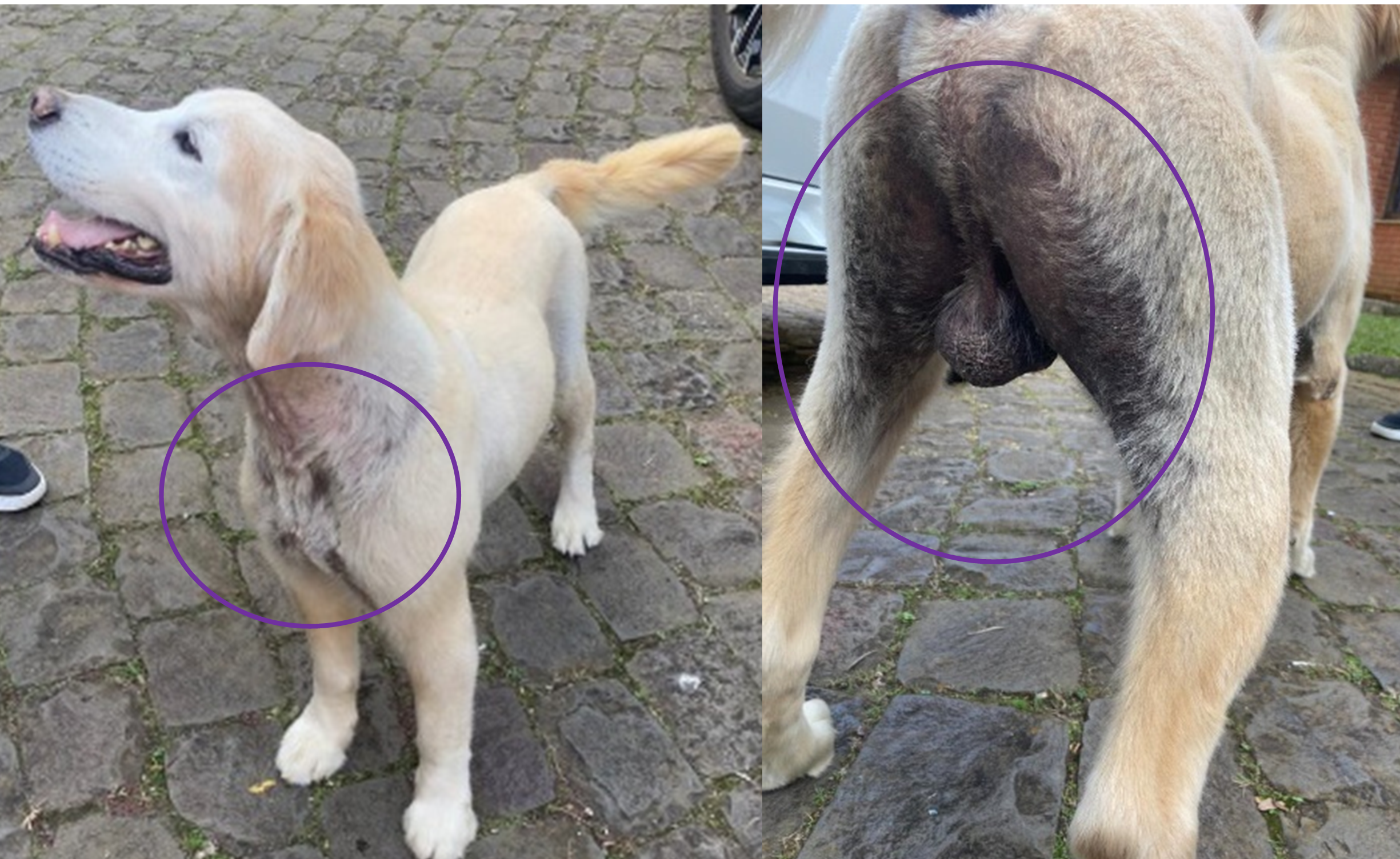
Sertolioma, or Sertoli cell tumour, is a functional testicular neoplasm that may induce feminization syndrome and non-pruritic symmetrical alopecia. We report the case of an intact 11-year-old male Golden Retriever, presented in May 2023 with progressive alopecia on the flanks and tail, with the absence of pruritus or associated dermatological lesions. Skin scrapings were negative for ectoparasites. Physical examination revealed testicular enlargement and asymmetry. Complete blood count, serum biochemistry, and thoracic radiographs showed no significant abnormalities. The dog underwent bilateral orchiectomy, and histopathological analysis confirmed a Sertoli cell tumour in the left testis, with contralateral testicular atrophy. Complete hair regrowth was observed 60 days post-surgery and no clinical recurrence was noted during the 12-month follow-up. This case highlights the importance of reproductive evaluation in cases of non-pruritic alopecia in senior dogs and emphasizes the favorable prognosis associated with early surgical intervention.
Sertolioma, or Sertoli cell tumour, is a functional testicular neoplasm that may induce feminization syndrome and non-pruritic symmetrical alopecia. We report the case of an intact 11-year-old male Golden Retriever, presented in May 2023 with progressive alopecia on the flanks and tail, with the absence of pruritus or associated dermatological lesions. Skin scrapings were negative for ectoparasites. Physical examination revealed testicular enlargement and asymmetry. Complete blood count, serum biochemistry, and thoracic radiographs showed no significant abnormalities. The dog underwent bilateral orchiectomy, and histopathological analysis confirmed a Sertoli cell tumour in the left testis, with contralateral testicular atrophy. Complete hair regrowth was observed 60 days post-surgery and no clinical recurrence was noted during the 12-month follow-up. This case highlights the importance of reproductive evaluation in cases of non-pruritic alopecia in senior dogs and emphasizes the favorable prognosis associated with early surgical intervention.
References
Adamo, I. D. (2018). Alopecia x: uma revisão de literatura. Universidade de Santo Amaro.
Agnew, W. D. W., & MacLachlan, A. N. N. J. (2017). Tumors of the genital systems. In D. J. Meuten (Ed.), Tumours in domestics animals (pp. 689–722). John Wiley & Sons.
Araujo, E., Silva, L. F., Oliveira, S., Dalanezi, F., Hayashi, R., Zahn, F., & Prestes, N. C. (2015). Mastose associada à neoplasia testicular em cão criptorquida. Enciclopédia Biosfera, 11(22), 2195–2201. https://doi.org/10.18677/Enciclopedia_Biosfera_2015_192.
Barbosa, R. G., Souza, E. J. D., Garcia, M. V. A., Costa, S. B., Cotta, T., & Tavares, M. C. O. (2021). Dermatopatia secundária ao hiperestrogenismo em cão macho: Relato de caso. PUBVET, 15(8), 1–4. https://doi.org/10.31533/pubvet.v15n08a883.1-4.
Carneiro, R. A., & Horta, R. S. (2013). Exame citológico das neoplasias. Cadernos Técnicos de Veterinária e Zootecnia, 70, 29–37.
Carvalho, C. F. (2004). Ultrassonografia em pequenos animais (Vol. 1). Roca.
Cavalcante, G. F. A., Jaworski, L. T. B. N., Olinda, R. G., & Machado, V. P. (2021). Seminoma e leydigocitoma em testículo ectópico canino: Relato de caso. PUBVET, 15(12), 1–7. https://doi.org/10.31533/pubvet.v15n12a988.1-7.
Ciaputa, R., Nowak, M., Kiełbowicz, M., Antończyk, A., Błasiak, K., & Madej, J. A. (2012). Seminoma, sertolioma, and leydigoma in dogs: Clinical and morphological correlations. Bulletin of the Veterinary Institute in Pulawy, 56(3), 361–367. https://doi.org/10.2478/v10213-012-0063-8.
Dahlbom, M., Mäkinen, A., & Suominen, J. (1997). Testicular fine needle aspiration cytology as a diagnostic tool in dog infertility. Journal of Small Animal Practice, 38(11), 506–512. https://doi.org/10.1111/j.1748-5827.1997.tb03307.x.
Faria, B. M., Bertolo, P. H. L., Macedo, B. C., Giese, E. G., & Pereira, W. L. A. (2018). Sertolioma em um canino associado à criptorquidia. PUBVET, 12(1), 1–4. https://doi.org/10.22256/pubvet.v12n1a16.1-4.
Flores. F. S., Costa, E. P., Ferreira, P. I., Pigatto, A. M., & Rosa, C. C. (2023). Síndrome da feminização em cão com sertolioma. Acta Scientiae Veterinariae, 51(Sup).
Fossum, T. W. (2021). Cirurgia de pequenos animais (3ed.). Elsevier Editora.
Gazin, A. A., Vatnikov, Y. A., Sturov, N. V., Kulikov, E. V., Grishin, V., Krotova, E. A., Razumova, A. A., Rodionova, N. Y., Troshina, N. I., Byakhova, V. M., & Lisitskaya, K. V. (2022). Canine testicular tumors: An 11-year retrospective study of 358 cases in Moscow Region, Russia. Veterinary World, 15(2), 483–487. https://doi.org/10.14202/vetworld.2022.483-487.
Goldschmidt, M. H., & Hendrick, M. J. (2008). Tumors of the skin and soft tissues. In D. J. Meuten (Ed.), Tumors in Domestic Animals, Fourth Edition (pp. 45–117). Iowa State Press.
Gondim, A. L. C. L., & Araújo, A. K. L. (2020). Alopecia X em cães: revisão. PUBVET, 14(5), 1–8. https://doi.org/10.31533/pubvet.v14n5a573.1-8.
Grieco, V., Riccardi, E., Greppi, G. F., Teruzzi, F., Iermanò, V., & Finazzi, M. (2008). Canine testicular tumours: A study on 232 dogs. Journal of Comparative Pathology, 138(2–3). https://doi.org/10.1016/j.jcpa.2007.11.002.
Grünert, E., Birgel, E. H., Vale, W. G., & Birgel Júnior, E. H. (2005). Patologia e clínica da reprodução dos animais mamíferos domésticos: Ginecologia. Varela Editora e Livraria Ltda.
Gutierrez, O. D., Rodríguez, G. J., & Buitrago, J. A. (2020). Tumor de células de Sertoli en un canino macho sin criptorquidismo: reporte de caso. Revista de Investigaciones Veterinarias del Perú, 30(4). https://doi.org/10.15381/rivep.v30i4.14755.
Holst, B. S., & Dreimanis, U. (2015). Anti-Müllerian hormone: A potentially useful biomarker for the diagnosis of canine Sertoli cell tumours. BMC Veterinary Research, 11(1), 116. https://doi.org/10.1186/s12917-015-0487-5.
Lavalle, G. E., Araújo, R. B., Carneiro, R. A., & Pereira, L. C. (2003). Punção aspirativa por agulha fina para diagnóstico de mastocitoma em cães. Arquivo Brasileiro de Medicina Veterinária e Zootecnia, 55(4), 500–502. https://doi.org/10.1590/s0102-09352003000400017.
Longhi, V., Longhi, I., & Noronha, F. S. (2023). Sertolioma em cão criptorquida idoso com metástase pulmonar: Relato de caso. PUBVET, 17(11), e1471. https://doi.org/0.31533/pubvet.v17n11e1471.
Marques, B. A. S., Carvalho, P. F. G., Almeida, A. C. S., Poletto, B. C., Fantin, M. C. C., & Dias, R. F. (2019). Sertolioma em cão associado a criptorquidismo: Relato de caso. Revista de Educação Continuada em Medicina Veterinária e Zootecnia do CRMV-SP, 18(2). https://doi.org/10.36440/recmvz.v18i1.37990.
Masserdotti, C., Lorenzi, D., & Gasparotto, L. (2008). Cytologic detection of Call-Exner bodies in Sertoli cell tumors from 2 dogs. Veterinary Clinical Pathology, 37(1), 112. https://doi.org/10.1111/j.1939-165X.2008.00009.x.
Meuten, D. J. (2016). Tumors in domestic animals. John Wiley & Sons.
Nascimento, E. F., & Santos, R. L. (2021). Patologia da reprodução dos animais domésticos (4ed.). Guanabara Koogan.
Nascimento, H. H., Santos, A., Prante, A. L., Lamego, E. C., Tondo, L. A. S., Flores, M. M., Fighera, R. A., & Kommers, G. D. (2020). Testicular tumors in 190 dogs: Clinical, macroscopic and histopathological aspects1. Pesquisa Veterinaria Brasileira, 40(7). https://doi.org/10.1590/1678-5150-PVB-6615.
Nelson, R., & Couto, C. G. (2015). Medicina interna de pequenos animais (3.ed.). Elsevier Brasil.
Nielsen, S. W. W., & Kennedy, P. C. C. (1990). Tumors of the genital systems. In J. E. Moulton (Ed.), Tumors of the genital systems (pp. 479–513). Nielsen S.W., Kennedy P.C. (1990). Tumors of the genital systems. In: Moulton J.E., Tumors in domestics animals. University of California Press, Berkeley, United States of América.
Penninck, D. G., & D’Anjou, M. A. (2011). Atlas de ultrassonografia de Pequenos animais (p. 513p.). Guanabara Koogan.
Peters, M. A. J., De Jong, F. H., Teerds, K. J., De Rooij, D. G., Dieleman, S. J., & Van Sluijs, F. J. (2000). Ageing, testicular tumours and the pituitary-testis axis in dogs. Journal of Endocrinology, 166(1), 153–161. https://doi.org/10.1677/joe.0.1660153.
Peters, M. A. J., & Van Sluijs, F. J. (1996). Testicular tumours in dogs: A review. Tijdschrift Voor Diergeneeskunde, 121(2).
Pliego, C. M., Ferreira, M. L. G., Ferreira, A. M. R., & Leite, J. S. (2008). Sertolioma metastático em cão. Veterinária e Zootecnia, 15(3), 56–57.
Priebe, A. P. S., Riet-Correa, G., Paredes, L. J. A., Costa, M. S. F., Silva, C. D. C., & Almeida, M. B. (2011). Ocorrência de neoplasias em cães e gatos da mesorregião metropolitana de Belém, PA entre 2005 e 2010. Arquivo Brasileiro de Medicina Veterinária e Zootecnia, 63(6), 1583–1586.
Raskin, R. E., & Meyer, D. J. (2011). Citologia de cães e gatos: Atlas colorido e guia de interpretação. Elsevier Brasil.
Rial, A. F., Walesca, S., Yamanaka, V. S., Cassanego, L. H., Meirelles, A. C. F., & Martins, L. G. A. (2010). Relato de caso: Hiperestrogenismo em cão decorrente de sertolioma. PUBVET, 4, 1–5.
Rodríguez, B. J., Ortiz, L. C., Garzón, A., Gómez, L. F., & Vásquez, Y. (2009). Valoración de la citología para el diagnóstico de tumores en caninos. Revista Colombiana de Ciencias Pecuarias, 22(1), 42–53.
Santos, R. L., & Alessi, A. C. (2018). Patologia veterinária (Vol. 1). Guanabara Koogan.
Santos, R. L., Silva, C. M., Ribeiro, A. F. C., & Serakides, R. (2000). Testicular tumors in dogs: Frequency and age distribution. Arquivo Brasileiro de Medicina Veterinária e Zootecnia, 52(1). https://doi.org/10.1590/S0102-09352000000100007.
Scileski, M. S., Souza, A. L., & Witz, M. I. (2019). Seminoma e sertolioma em cão criptorquida: Relato de caso. Veterinária em Foco, 46–52.
Staut, J. L., Assef, M. L. M., & Cirio, S. M. (2007). Estudo histoquímico da matriz extracelular de neoplasias testiculares de cães (Canis familiares Linnaeus, 1758). Estudos de Biologia, 29(68/69), 243–247. https://doi.org/10.7213/reb.v29i68/69.22774.
Švara, T., Gombač, M., Pogorevc, E., Plavec, T., Zrimšek, P., & Pogaenik, M. (2014). A retrospective study of canine testicular tumours in Slovenia. Slovenian Veterinary Research, 51(2), 81–88.
Teixeira, L. V, Lopes, S. T. A., Martins, D. B., França, R. T., & Fighera, R. A. (2010). Punção aspirativa por agulha fina como método de coleta de material para a histopatologia no osteossarcoma canino. Pesquisa Veterinária Brasileira, 30(2), 132–138. https://doi.org/10.1590/s0100-736x2010000200008.
Teske, E., Naan, E. C., Van Dongen, A. M., & Lagers, M. N. (1991). Histopathological classification and incidence of canine testicular tumours. Veterinary Pathology, 28, 225–232.
Trindade, D. B. M., Cavalheiro, A. L. B., Lopes, A. A., Santurio, S. T., Mazzanti, J. M., & Eduardo Schossler, J. E. (2008). Diagnóstico de criptococose canina pela citologia aspirativa por agulha fina. Ciência Rural, 38(3), 1–6.
Valenciano, A. C., & Cowell, R. L. (2019). Cowell and Tyler’s diagnostic cytology and hematology of the dog and cat-E-Book. Elsevier Health Sciences. https://doi.org/DOI: 10.1016/c2016-0-02017-x.
Vieira, C. R., Suzano, S. M., Silveira, A. M., Pires, M. V, Libonati, J., & Ferreira, A. M. R. (2010). Avaliação clínica, citológica e seminal de gatos domésticos (Felis catus) para seleção de reprodutores. Revista Eletrônica Novo Enfoque, 9(9), 7–9.
Wurdel, M. M., & Luxinger, A. O. (2023). Tumor de células de Leydig & espermatocele em testículo canino: Relato de caso. Revista Ibero-Americana de Humanidades, Ciências e Educação, 9(6), 1771–1778. https://doi.org/10.51891/rease.v9i6.10176.
Zaldivar, L. (2007). Enfermedades del aparato reproductor del perro. Manula.
Downloads
Published
Issue
Section
License
Copyright (c) 2025 Ana Paula Barbusa Hoberg, Fernanda Dickel de Andrade, Juliana Bonfim da Silveira

This work is licensed under a Creative Commons Attribution 4.0 International License.
Você tem o direito de:
Compartilhar — copiar e redistribuir o material em qualquer suporte ou formato
Adaptar — remixar, transformar, e criar a partir do material para qualquer fim, mesmo que comercial.
O licenciante não pode revogar estes direitos desde que você respeite os termos da licença. De acordo com os termos seguintes:
Atribuição
— Você deve dar o crédito apropriado, prover um link para a licença e indicar se mudanças foram feitas. Você deve fazê-lo em qualquer circunstância razoável, mas de nenhuma maneira que sugira que o licenciante apoia você ou o seu uso. Sem restrições adicionais
— Você não pode aplicar termos jurídicos ou medidas de caráter tecnológico que restrinjam legalmente outros de fazerem algo que a licença permita.