Use of hyperbaric oxygen therapy in the treatment of suture dehiscence in a dog
Case report
DOI:
https://doi.org/10.31533/pubvet.v19n06e1789Keywords:
Healing, oxygen, veterinary medicine, woundAbstract
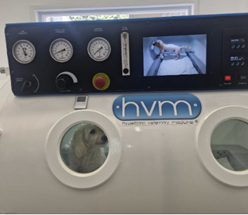
The aim of this study was to report the case of a 14-year-old female dog that presented suture dehiscence and was treated with hyperbaric oxygen therapy. Suture dehiscence is a postoperative complication characterized by partial or complete reopening of the suture line, which may result in infection and delayed wound healing. The causes are multifactorial and include inadequate surgical techniques, infection, poor nutrition, use of medications that impair healing, and chronic diseases. Clinical signs include severe pain, swelling, redness, purulent discharge, bleeding and, in severe cases, evisceration. A 14-year-old spayed poodle, weighing seven kg, was seen on April 16, 2024, with intense abdominal pain and a suspected splenic mass. Ultrasound examination revealed cholelithiasis and dilated bile ducts. Hematological tests showed thrombocytopenia, leukopenia, and lymphopenia. The dog underwent a cholecystectomy and a splenectomy, and splenic samples were sent for histopathological analysis, which revealed congestion and lymphoid hyperplasia. After surgery, the animal was hospitalized and treated with analgesics and antibiotics. During follow-up, neutrophilic leukocytosis was observed, along with a positive test for Ehrlichia antibodies, leading to the introduction of DoxifinTabs®. On April 20, suture dehiscence occurred at three surgical sites, requiring a new intervention. On April 24, the presence of bloody exudate and necrosis led to drainage and the recommendation of hyperbaric oxygen therapy. This treatment modality, still uncommon in veterinary medicine in Brazil, has shown efficacy in managing hard-to-heal wounds, highlighting the need for further studies and the expansion of access to this resource.
References
Arias, M. V. B., Aiello, G., Battaglia, L. A., & Freitas, J. C. (2013). Estudo da ocorrência de infecção hospitalar em cães e gatos em um centro cirúrgico veterinário universitário. Pesquisa Veterinária Brasileira, 33, 771–779. https://doi.org/10.1590/S0100-736X2013000600014.
Barone, G. (2015). Tratado de medicina veterinária. Guanabara Koogan S.A.
CFMV. (2017). Código de ética do médico veterinário. Diário Oficial da União.
Ferreira, R., & Bandeira, T. (2003). Oxigenoterapia de longa duração em pediatria: Lições do passado e orientações para o futuro. Acta Pediatrica Portuguesa, 34, 69–78.
Fossum, T. W. (2021). Cirurgia de pequenos animais (3ed.). Elsevier Editora.
Jericó, M. M., Andrade Neto, J. P., & Kogika, M. M. (2015). Tratado de medicina interna de cães e gatos. Roca Ltda.
Johnson, K. A., Watson, A. D. J., Ettinger, S. J., & Feldman, E. C. (2004). Tratado de Medicina Interna Veterinária: doenças do cão e do gato. Manole Ltda.
Jumaa, B. H., & Al-hasan, A. M. (2012). Laparoscopic versus open total splenectomy in dogs. Iraqi Journal of Veterinary Sciences, 26(Suppl. III). https://doi.org/10.33899/ijvs.2012.168690.
Larsson, C. E., & Lucas, R. (2016). Tratado de medicina externa: dermatologia veterinária. Interbook.
Mazzi, M. F. (2018). A utilização da oxigenoterapia hiperbárica no tratamento de fasceíte necrotizante do prepúcio de um cão idoso. PUBVET, 12(7), 1–7. https://doi.org/10.22256/pubvet.v12n7a122.1-7
Mazzi, M. F., & Dias, M. D. (2018). Ceratite ulcerativa corneana traumática em cão; tratamento com oxigenoterapia hiperbárica. PUBVET, 12(12), 1–8. https://doi.org/10.31533/pubvet.v12n12a226.1-8
Rabelo, R. (2012). Emergências em pequenos animais: Condutas clínicas e cirúrgicas no paciente grave. Elsevier Brasil.
Simpson, A. C., & Wiener, D. J. (2021). Positive effects of hyperbaric oxygen therapy in a cat with cutaneous nocardiosis. Veterinary Dermatology, 32(4), 392-e112. https://doi.org/10.1111/vde.12978.
Stedile, R., Beck, C. A. C., Schiochet, F., Ferreira, M. P., Oliveira, S. T., Martens, F. B., Tessari, J. P., Bernades, S. B. L., Oliveira, C. S., Santos, A. P., Mello, F. P. S., Alievi, M. M., & Muccillo, M. S. (2009). Laparoscopic versus open splenectomy in dogs. Pesquisa Veterinária Brasileira, 29(8). https://doi.org/10.1590/s0100-736x2009000800009.
Tostes, R. A., Reis, S. T. J., & Castilho, V. V. (2017). Tratado de medicina veterinária legal (Vol. 1). MedVep.
Zimmermann, M., Raiser, A. G., Mazzanti, A., Lopes, S. T. dos A., & Salbego, F. Z. (2006). Peritonitis in dogs. Ciência Rural, 36(5), 1655–1663. https://doi.org/10.1590/s0103-84782006000500052.
Downloads
Published
Issue
Section
License
Copyright (c) 2025 Vitória Cristina Carvalho Ribeiro, Juliana Paes, Erica Alves da Silva, Juliana Ramos Cavalcante, Thereza Cristina de Vasconcelos

This work is licensed under a Creative Commons Attribution 4.0 International License.
Você tem o direito de:
Compartilhar — copiar e redistribuir o material em qualquer suporte ou formato
Adaptar — remixar, transformar, e criar a partir do material para qualquer fim, mesmo que comercial.
O licenciante não pode revogar estes direitos desde que você respeite os termos da licença. De acordo com os termos seguintes:
Atribuição
— Você deve dar o crédito apropriado, prover um link para a licença e indicar se mudanças foram feitas. Você deve fazê-lo em qualquer circunstância razoável, mas de nenhuma maneira que sugira que o licenciante apoia você ou o seu uso. Sem restrições adicionais
— Você não pode aplicar termos jurídicos ou medidas de caráter tecnológico que restrinjam legalmente outros de fazerem algo que a licença permita.