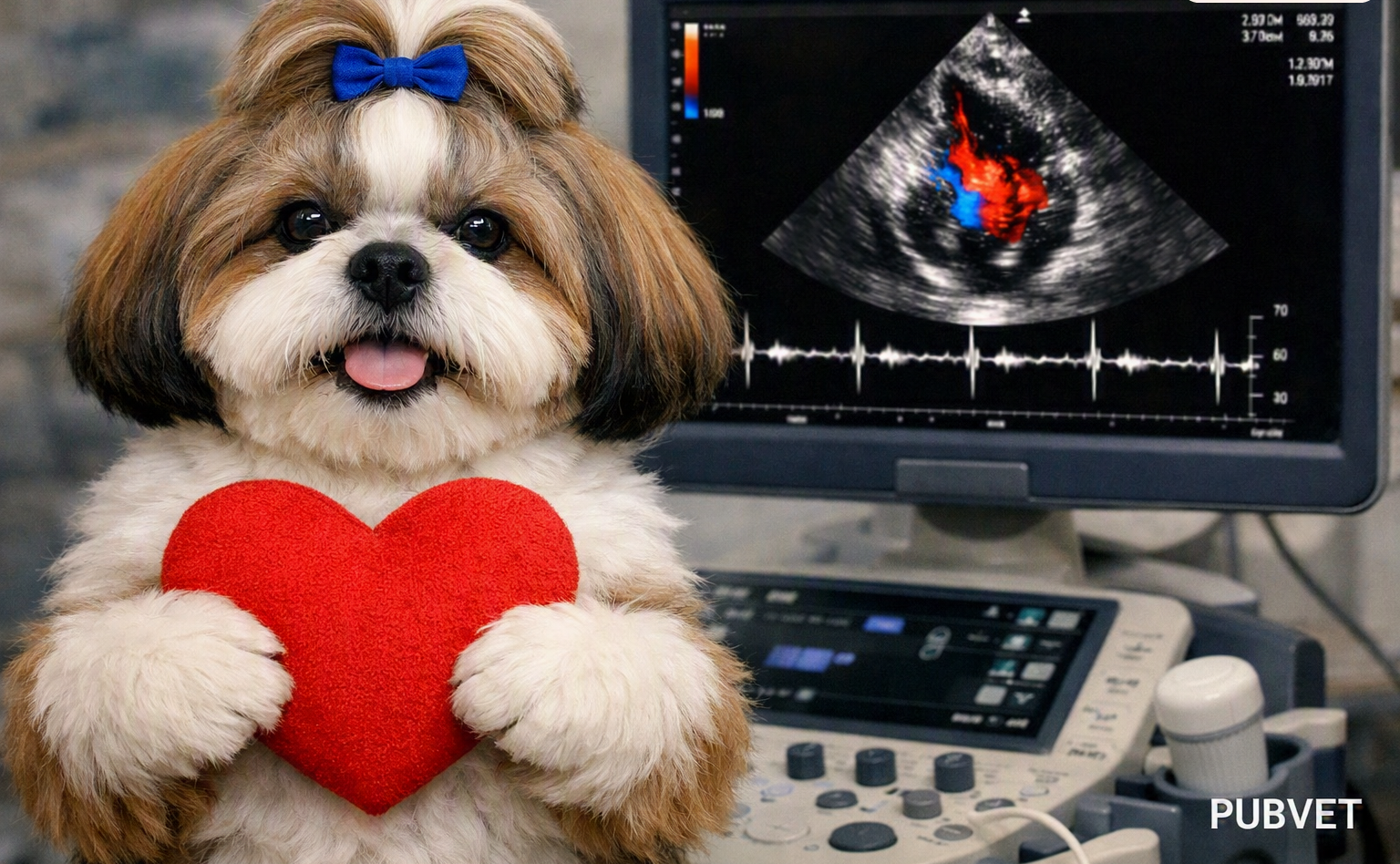
Serial echocardiographic evaluation in a Shih Tzu dog with myxomatous mitral valve disease
Case report
DOI:
https://doi.org/10.31533/pubvet.v20n7e1985Keywords:
Diastole, hemodynamics, prognosis, regurgitation, remodelingAbstract
Myxomatous mitral valve disease (MMVD) is the most prevalent cardiac disease in small animal practice, requiring careful monitoring to determine the optimal timing for therapeutic intervention. This study reports the serial echocardiographic follow-up of a 10-year-old male Shih Tzu dog diagnosed with MMVD. Two echocardiographic examinations were performed at a three-month interval (from February to May 2026). At the first examination, the patient presented with mild left atrial enlargement (left atrium-to-aorta [LA/Ao] ratio of 1.62) and significant mitral regurgitation. At the second examination, progression of left atrial dilation (LA/Ao ratio of 1.69) and increased ventricular contractility (ejection fraction increasing from 67% to 79%) were observed, suggesting that the patient was approaching the criteria used for ACVIM stage B2. Comparative analysis demonstrated the importance of Doppler echocardiography for the early detection of hemodynamic alterations and for risk stratification of congestive heart failure. It is concluded that serial monitoring is essential for the appropriate clinical management of myxomatous mitral valve disease in predisposed breeds.
References
Balzan, G., Rodrigues, A. S., Malaggi, V. B., Bortolanza, M. C., Santos, J. B., & Llorente, M. (2021). Insuficiencia cardíaca congestiva: evolución clínica, enfermedades relacionadas - Informe de caso. Epicentro - Revista de Investigación Ciencias de la Salud, 1(1). https://doi.org/10.59085/2789-7818.2021.10.
Bonagura, J. D., & Lehmkuhl, L. B. (1999). Clinical echocardiography of the dog and cat. In: Fox PR, Sisson D, Moïse NS (Eds.). Textbook of Canine and Feline Cardiology: Principles and Clinical Practice. 2nd ed. Philadelphia: Saunders.
Boon, J. A. (2011). Veterinary Echocardiography. 2nd ed. Ames: Wiley-Blackwell.
Boswood, A., Häggström, J., Gordon, S. G., Wess, G., Stepien, R. L., Oyama, M. A., Keene, B. W., Bonagura, J., MacDonald, K. A., & Patteson, M. (2016). Effect of pimobendan in dogs with preclinical myxomatous mitral valve disease and cardiomegaly: the EPIC study—a randomized clinical trial. Journal of Veterinary Internal Medicine, 30(6), 1765–1779. https://doi.org/10.1016/j.asams.2017.03.008.
Detofano, J., Silva, A. C. A., Almeida, L. G., Mattei, A. S., Giordani, C., Castro, L. L. D., & Guterres, K. A. (2024). Bloqueio atrioventricular de terceiro grau associado à doença valvar mixomatosa de valva mitral, aórtica e tricúspide em um cão idoso: Relato de caso. Revista Inovavet, 2(1). https://doi.org/10.18226/30855713.v2.n1.04.
Dobler, G. H., Oliveira, H. S., & Almeida, M. R. (2023). Estudo anatômico das lesões endocardiose em cães, prevalência e epidemiologia. Arquivos de Ciências Veterinárias e Zoologia da UNIPAR, 26(1cont). https://doi.org/10.25110/arqvet.v26i1cont-006.
Keene, B. W., Atkins, C. E., Bonagura, J. D., Fox, P. R., Häggström, J., Fuentes, V. L., Oyama, M. A., Rush, J. E., Stepien, R., & Uechi, M. (2019). ACVIM consensus guidelines for the diagnosis and treatment of myxomatous mitral valve disease in dogs. Journal of Veterinary Internal Medicine, 33(3), 1127–1140. https://doi.org/10.1111/jvim.15488. Acesso em: 2 abr. 2020.
Morgan, K. R. S., Monteith, G., Raheb, S., Colpitts, M., & Fonfara, S. (2020). Echocardiographic parameters for the assessment of congestive heart failure in dogs with myxomatous mitral valve disease and moderate to severe mitral regurgitation. The Veterinary Journal, 263, 105518. https://doi.org/10.1016/j.tvjl.2020.105518.
Oliveira, E. C. V. (2026). Análise Eletrocardiográfica em Pacientes Veterinários. Anais do Congresso Brasileiro de Cardiologia Veterinária.
Oyama, M. A. (2015). Pathogenesis of canine myxomatous mitral valve disease: current concepts and future directions. Veterinary Journal, 206(1), 6-15.
Perin, C., Bariani, M. H., Franco, D. F., & Filadelpho, A. L. (2007). Endocardiose da valva mitral em cães. Revista Cientifica de Medicina Veterinária, 8.
Reinero, C., Visser, L. C., Kellihan, H. B., Masseau, I., Rozanski, E., Clercx, C., Williams, K., Abbott, J., Borgarelli, M., & Scansen, B. A. (2020). ACVIM consensus statement guidelines for the diagnosis, classification, treatment, and monitoring of pulmonary hypertension in dogs. Journal of Veterinary Internal Medicine, 34(2), 549–573. https://doi.org/10.1111/jvim.15725.
Reynolds, C. A., Brown, D. C., Rush, J. E., Fox, P. R., Nguyenba, T. P., Lehmkuhl, L. B., Gordon, S. G., Kellihan, H. B., Stepien, R. L., Lefbom, B. K., Kate Meier, C., & Oyama, M. A. (2012). Prediction of first onset of congestive heart failure in dogs with degenerative mitral valve disease: The PREDICT cohort study. Journal of Veterinary Cardiology, 14(1), 193–202. https://doi.org/10.1016/j.jvc.2012.01.008.
Schober, K. E., Hart, T. M., Stern, J. A., Li, X., Samii, V. F., Zekas, L. J., Scansen, B. A., & Bonagura, J. D. (2010). Detection of congestive heart failure in dogs by Doppler echocardiography. Journal of Veterinary Internal Medicine, 24(6), 1358–1368. https://doi.org/10.1111/j.1939-1676.2010.0592.x.
Silva, T. L. S., Silva, A. T., Lima, E. P. O., Santos, C. C., Santos, C. S., Caminha, M. F. C., & Silva, S. L. (2022). Diagnósticos e intervenções de enfermagem para pacientes com insuficiência cardíaca congestiva em unidade de terapia intensiva: revisão integrativa. Revista Eletrônica Acervo Saúde, 15(2). https://doi.org/10.25248/reas.e9724.2022.
Downloads
Published
Issue
Section
License
Copyright (c) 2026 Tatiane Layla Gonçalves, Renata Benedetti Cepinho

This work is licensed under a Creative Commons Attribution 4.0 International License.
Você tem o direito de:
Compartilhar — copiar e redistribuir o material em qualquer suporte ou formato
Adaptar — remixar, transformar, e criar a partir do material para qualquer fim, mesmo que comercial.
O licenciante não pode revogar estes direitos desde que você respeite os termos da licença. De acordo com os termos seguintes:
Atribuição
— Você deve dar o crédito apropriado, prover um link para a licença e indicar se mudanças foram feitas. Você deve fazê-lo em qualquer circunstância razoável, mas de nenhuma maneira que sugira que o licenciante apoia você ou o seu uso. Sem restrições adicionais
— Você não pode aplicar termos jurídicos ou medidas de caráter tecnológico que restrinjam legalmente outros de fazerem algo que a licença permita.