Singleton puppy syndrome in a bitch and the importance of neonatal resuscitation following cesarean section
Case report
DOI:
https://doi.org/10.31533/pubvet.v20n5e1956Keywords:
Apgar score, canine obstetrics, uterine inertia, fetal distress, veterinary neonatologyAbstract
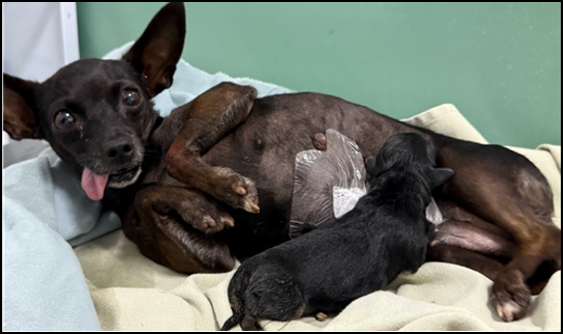
Neonatal viability in dogs is directly associated with appropriate parturition management and early intervention in obstetric disorders. Singleton Puppy Syndrome is characterized by the presence of a single fetus, resulting in insufficient uterine distension and failure to trigger the physiological onset of labor, which may lead to primary uterine inertia, fetal distress, and increased perinatal mortality. This study reports a case of Singleton Puppy Syndrome in a bitch undergoing timely cesarean section, emphasizing the importance of basic neonatal resuscitation in reversing neonatal depression. A bitch with prolonged gestation and absence of labor signs underwent cesarean section following ultrasonographic and radiographic diagnosis consistent with a singleton fetus and high obstetric risk. The neonate presented an initial Apgar score of 2, and basic neonatal resuscitation procedures were immediately initiated, including active warming, airway clearance, tactile stimulation, oxygen therapy, and stimulation of the GV26 acupoint. Progressive improvement in neonatal vitality was observed, with the Apgar score increasing to 9 within 60 minutes, ensuring the puppy's survival. It is concluded that early diagnosis of Singleton Puppy Syndrome, timely surgical intervention, and the systematic application of neonatal resuscitation protocols are critical factors for improving neonatal survival in high-risk cesarean deliveries.
References
Barbosa, E. R., Costa, A. S., Napoleão, R. M. S., Ferreira, M. R., & Andrade, K. E. R. (2021). Cuidados básicos e intensivos com neonato canino no parto cirúrgico (Cesariana): Uma revisão de literatura. https://doi.org/10.51161/rems/2397.
Boller, M., Burkitt-Creedon, J. M., Fletcher, D. J., Byers, C. G., Davidson, A. P., Farrell, K. S., Bassu, G., Fausak, E. D., Grundy, S. A., Lopate, C., & Veronesi, M. C. (2025). Recover Guidelines: Newborn Resuscitation in Dogs and Cats. Clinical Guidelines. Journal of Veterinary Emergency and Critical Care, 35(S1). https://doi.org/10.1111/vec.70013.
Cavanagh, A. A. (2017). Neonatal resuscitation in the veterinary setting. Clinician’s Brief.
Davidson, A. P. (2025). Management of the Neonate in Dogs and Cats. In Merck Veterinary Manual (Vol. 1, Number 1).
Doebeli, A., Michel, E., Bettschart, R., Hartnack, S., & Reichler, I. M. (2013). Apgar score after induction of anesthesia for canine cesarean section with alfaxalone versus propofol. Theriogenology, 80(8). https://doi.org/10.1016/j.theriogenology.2013.07.006.
Leite, A. G. P. M. L., Cordeiro, M. L. L., Albuquerque, S. C. M., Dias, F. E. F., Arrivabene, M., & Cavalcante, T. V. (2019). Escore APGAR: Aplicação em neonatos caninos nascidos de parto normal e cesariana. PUBVET, 13(4), 1–5. https://doi.org/10.31533/pubvet.v13n4a318.1-5.
Linklater, A. (2025). Triagem inicial e reanimação de pacientes de emergência de pequenos animais. In Merck Veterinary Manual (Vol. 1, Number 1).
Lourenço, M. L. G., Knupp, F. C., Pereira, K. H. N. P., Fuchs, K. M., Xavier, G. M., Mendonça, J. C., Tsunemi, M. H., Souza, F. F., & Joaquim, J. G. F. (2025). Efficacy of VG26 and K1 acupuncture points in cardiopulmonary resuscitation of neonatal puppies born by cesarean section. Frontiers in Veterinary Science, 12. https://doi.org/10.3389/fvets.2025.1579758.
Mathews, K. A. (2005). Analgesia for the pregnant, lactating and neonatal to pediatric cat and dog. Journal of Veterinary Emergency and Critical Care, 15(4). https://doi.org/10.1111/j.1476-4431.2005.00170.x.
Mugnier, A., Chastant, S., Saegerman, C., Gaillard, V., Grellet, A., & Mila, H. (2021). Management of low birth weight in canine and feline species: Breeder profiling. Animals, 11(10). https://doi.org/10.3390/ani11102953.
Pereira, K. H. N. P., Correia, L. E. C. S., Oliveira, E. L. R., Bouéres, C. S., Cyrino, M. A., Leis Filho, A. F., Cruz, R. K. S., Angrimani, D. S. R., Souza, F. F., Chiacchio, S. B., & Lourenço, M. L. G. (2020). Effects of clamping umbilical cord on the neonatal viability of puppies delivered by cesarean section. Journal of Veterinary Medical Science, 82(2). https://doi.org/10.1292/jvms.19-0078.
Srithunyarat, T., Jitpean, S., Wipoosak, P., Nonthakotr, C., Boonbal, N., Kunkitti, P., & Seesupa, S. (2024). Apgar scores in puppies following the induction of etomidate compared with alfaxalone or propofol for cesarean section. Veterinary World, 17(3), 527–534. https://doi.org/10.14202/vetworld.2024.527-534.
Veronesi, M. C. (2016). Apgar score in puppies delivered by cesarean section: Correlation with neonatal survival. Theriogenology, 85(5), 979–985.
Downloads
Published
Issue
Section
License
Copyright (c) 2026 Beatriz Doná Símaro, Beatriz Piva Vicentini, Suelen Lorena da Silva, Luís Guilherme de Faria, Luana Martins Serra, Fernando Fernandes Marques, Lucas da Silva Gois

This work is licensed under a Creative Commons Attribution 4.0 International License.
Você tem o direito de:
Compartilhar — copiar e redistribuir o material em qualquer suporte ou formato
Adaptar — remixar, transformar, e criar a partir do material para qualquer fim, mesmo que comercial.
O licenciante não pode revogar estes direitos desde que você respeite os termos da licença. De acordo com os termos seguintes:
Atribuição
— Você deve dar o crédito apropriado, prover um link para a licença e indicar se mudanças foram feitas. Você deve fazê-lo em qualquer circunstância razoável, mas de nenhuma maneira que sugira que o licenciante apoia você ou o seu uso. Sem restrições adicionais
— Você não pode aplicar termos jurídicos ou medidas de caráter tecnológico que restrinjam legalmente outros de fazerem algo que a licença permita.