Treatment and survival of a dog diagnosed with multiple myeloma using Viscum album therapy
Case report
DOI:
https://doi.org/10.31533/pubvet.v20n4e1932Keywords:
Homeopathy, integrative veterinary oncology, survivalAbstract
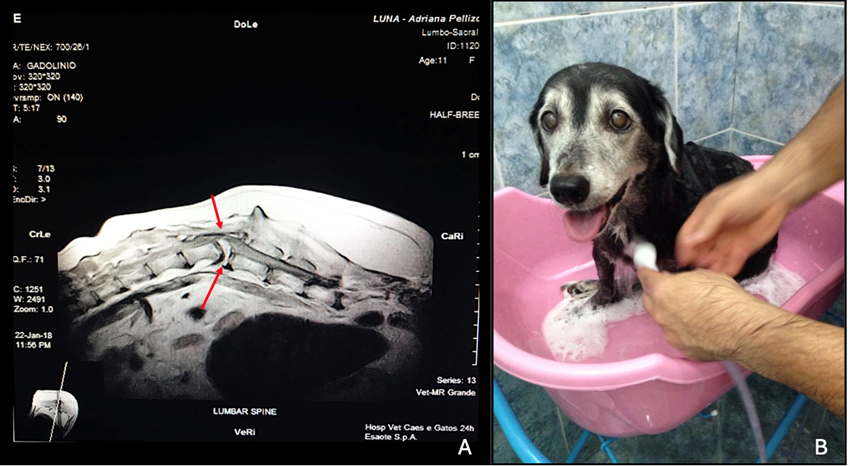
Multiple myeloma is a plasma cell neoplasm that accounts for approximately 1% of all tumors in dogs and is more commonly diagnosed in elderly animals. Clinical signs are generally nonspecific and may include bone pain, lethargy, hematologic abnormalities, and systemic involvement. Conventional treatment is based on chemotherapy, which may provide variable clinical responses; however, the disease remains incurable, with a guarded prognosis and limited survival time. Given these therapeutic challenges and the increasing incidence of neoplasms in both human and veterinary medicine, there is growing interest in integrative approaches. In this context, Viscum album has been used for over a century in anthroposophic medicine for the treatment of cancer patients and, more recently, has been applied in homeopathic formulations, with promising results reported in the literature, including good tolerability, absence of significant adverse effects, and potential modulatory activity. This report describes the case of an 11-year-old mixed-breed dog diagnosed with multiple myeloma affecting a lumbar vertebra, which did not undergo conventional treatment and achieved a survival time of six years after diagnosis. An integrative therapeutic approach was adopted using injectable homeopathic Viscum album, administered daily in different potencies. After six months of follow-up, remodeling of the affected vertebra was observed, with no evidence of disease progression. The patient was monitored longitudinally, demonstrating a six-year survival with good quality of life until death due to age-related natural causes at 17 years of age. This study aims to report a clinical case, highlighting the favorable outcome of a patient diagnosed with multiple myeloma treated with homeopathic Viscum album, suggesting its potential as an integrative therapy. To date, this represents one of the first reports in the literature describing such a clinical evolution for this condition.
References
Cogo, E., Elsayed, M., Bhardwaj, S., Cooley, K., Aycho, C., Liang, V., Papadogianis, P., Psihogios, A., & Seely, D. (2023). Mistletoe Extracts During the Oncological Perioperative Period: A Systematic Review and Meta-Analysis of Human Randomized Controlled Trials. Current Oncology, 30(9). https://doi.org/10.3390/curroncol30090595.
Daleck, C. R., Fonseca, C. S., & Canola, J. C. (2016). Oncologia em cães e gatos. Roca.
Geigy, C., Riond, B., Bley, C. R., Grest, P., Kircher, P., & Lutz, H. (2013). Multiple myeloma in a dog with multiple concurrent infectious diseases and persistent polyclonal gammopathy. Veterinary Clinical Pathology, 42(1), 47–54. https://doi.org/10.1111/vcp.12018.
Kauczor, G., Delebinski, C., Jäger, S., Seeger, K., & Seifert, G. (2012). Triterpene acid containing Viscum album L. extracts mediate apoptosis in pediatric solid cancer cells. BMC Complementary and Alternative Medicine, 12(S1). https://doi.org/10.1186/1472-6882-12-s1-p18.
Kienle, G. S., Grugel, R., & Kiene, H. (2011). Safety of higher dosages of Viscum album L. in animals and humans - systematic review of immune changes and safety parameters. BMC Complementary and Alternative Medicine, 11, 1–7. https://doi.org/10.1186/1472-6882-11-72.
Kienle, G. S., & Kiene, H. (2010). Influence of Viscum album L (European Mistletoe) Extracts on Quality of Life in Cancer Patients: A Systematic Review of Controlled Clinical Studies. Integrative Cancer Therapies, 9(2), 142–157. https://doi.org/10.1177/1534735410369673.
Kleinsimon, S., Kauczor, G., Jaeger, S., Eggert, A., Seifert, G., & Delebinski, C. (2017). Viscum TT induces apoptosis and alters IAP expression in osteosarcoma in vitro and has synergistic action when combined with different chemotherapeutic drugs. BMC Complementary and Alternative Medicine, 17(1). https://doi.org/10.1186/s12906-016-1545-7.
Klingemann, H. (2023). Viscum album (mistletoe) extract for dogs with cancer? Frontiers in Veterinary Science, 10. https://doi.org/10.3389/fvets.2023.1285354.
Matus, R. E., Leifer, C. E., MacEwen, E. G., & Hurvitz, A. I. (1986). Prognostic factors for multiple myeloma in the dog. Journal of the American Veterinary Medical Association, 188(11), 1288–1292. https://doi.org/10.2460/javma.1986.188.11.1288.
Ostermann, T., Appelbaum, S., Poier, D., Boehm, K., Raak, C., & Bussing, A. (2020). A Systematic Review and Meta-Analysis on the Survival of Cancer Patients Treated with a Fermented Viscum album L. Extract (Iscador): An Update of Findings. In Complementary Medicine Research (Vol. 27, Number 4). https://doi.org/10.1159/000505202
Rajkumar, S. V. (2014). Multiple myeloma: 2014 Update on diagnosis, risk-stratification, and management. American Journal of Hematology, 89(10), 999–1009. https://doi.org/10.1002/ajh.23810.
Stein, G. M., & Kummer, M. (2012). Therapeutic use of Viscum album in veterinary oncology: Mechanisms and clinical application. Veterinary Journal of Oncology, 3(2), 77–83.
Thrall, M. A., Weiser, G., Allison, R. W., & Campbell, T. W. (2022). Veterinary hematology, clinical chemistry, and cytology. John Wiley & Sons.
Tröger, W., Galun, D., Reif, M., Schumann, A., Stanković, N., & Milićević, M. (2014). Quality of Life of Patients with Advanced Pancreatic Cancer During Treatment with Mistletoe. Deutsches Ärzteblatt International, 1–9. https://doi.org/10.3238/arztebl.2014.0493.
Vail, D. M., Thamm, D. H., & Liptak, J. M. (2019). Withrow and MacEwen’s Small Animal Clinical Oncology-E-Book. Elsevier Health Sciences.
Valle, A. C. V., Valle, M. L. P. V., & Carvalho, A. C. (2024). Terapia Viscum album injetável no tratamento e sobrevida de paciente diagnosticado com carcinoma hepatóide. PUBVET, 18(3). https://doi.org/10.31533/pubvet.v18n03e1560.
Valle, A. C. V, & Valle, M. L. Z. (2025a). Tratamento homeopático de abscesso em cão: Relato de caso. PUBVET, 19(2), 1–5. https://doi.org/10.31533/pubvet.v19n02e1732.
Valle, A. C. V, & Valle, M. L. V. (2025b). Fibrossarcoma em cão jovem tratado com terapia injetável de Viscum album: Relato de caso. PUBVET, 1–6. https://doi.org/10.31533/pubvet.v19n03e1747.
Weissenstein, U., Kunz, M., Urech, K., & Baumgartner, S. (2014). Interaction of standardized mistletoe (Viscum album) extracts with chemotherapeutic drugs regarding cytostatic and cytotoxic effects in vitro. BMC Complementary and Alternative Medicine, 14(1), 1–9. https://doi.org/10.1186/1472-6882-14-6.
Withrow, S. J., Page, R., & Vail, D. M. (2020). Small animal clinical oncology. Elsevier Health Sciences. https://doi.org/10.1201/9781315381855.
Yousefvand, S., Fattahi, F., Hosseini, S. M., Urech, K., & Schaller, G. (2022). Viscotoxin and lectin content in foliage and fruit of Viscum album L. on the main host trees of Hyrcanian forests. Scientific Reports, 12(1), 10383. https://doi.org/10.1038/s41598-022-14504-3.
Downloads
Published
Issue
Section
License
Copyright (c) 2026 Ana Catarina Viana Valle, Maria Luíza Pereira Viana Valle, Aloísio Cunha de Carvalho

This work is licensed under a Creative Commons Attribution 4.0 International License.
Você tem o direito de:
Compartilhar — copiar e redistribuir o material em qualquer suporte ou formato
Adaptar — remixar, transformar, e criar a partir do material para qualquer fim, mesmo que comercial.
O licenciante não pode revogar estes direitos desde que você respeite os termos da licença. De acordo com os termos seguintes:
Atribuição
— Você deve dar o crédito apropriado, prover um link para a licença e indicar se mudanças foram feitas. Você deve fazê-lo em qualquer circunstância razoável, mas de nenhuma maneira que sugira que o licenciante apoia você ou o seu uso. Sem restrições adicionais
— Você não pode aplicar termos jurídicos ou medidas de caráter tecnológico que restrinjam legalmente outros de fazerem algo que a licença permita.