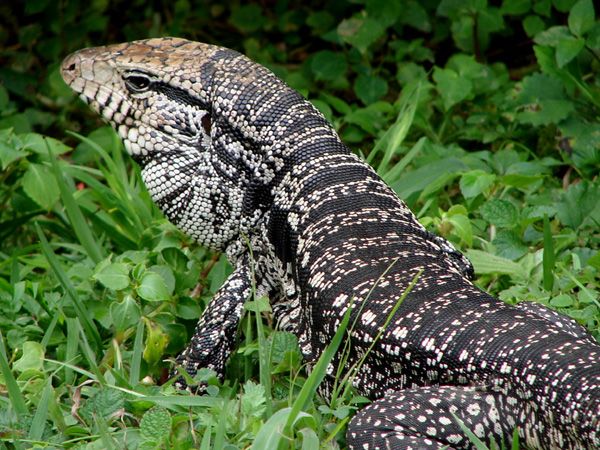
Fat bodies in tegu lizards (Salvator merianae): a report of anatomical findings during necropsy
DOI:
https://doi.org/10.31533/pubvet.v20n4e1943Keywords:
Anatomical pathology, ectothermic metabolism, energy reserve, reptilesAbstract
The objective of this study was to report the macroscopic finding of fat bodies in a specimen of Salvator merianae during necropsy examination, emphasizing their anatomical and physiological relevance to wildlife veterinary medicine. An adult male lizard weighing 3.2 kg was rescued from a public road presenting locomotor impairment. Radiographic examination revealed a dorsosacral vertebral fracture, and humane euthanasia was performed due to poor prognosis. Necropsy was conducted following a systematic technique, revealing hemoperitoneum and the presence of anthropogenic food remains in the gastrointestinal tract, as well as intestinal nematode parasitism. During removal of the visceral block, two paired, lobulated, yellowish, and vascularized structures were observed in the caudal portion of the coelomic cavity, adjacent to the kidneys and gonads, measuring approximately 10 cm each. A fragment submitted to water immersion showed immediate flotation, consistent with high lipid content. Based on morphological and topographical characteristics, the structures were identified as fat bodies, which represent the primary energy reserves in reptiles. This finding highlights the importance of recognizing these anatomical structures during necropsy procedures, contributing to accurate anatomical interpretation and improved understanding of adaptive metabolic strategies in ectothermic species. It is concluded that detailed macroscopic description of fat bodies represents a valuable tool in anatomical pathology and advances knowledge in wildlife veterinary medicine.
References
Bellairs, A. (1969). The Life of Reptiles: Skin (2th ed., Vol. 1). Weidenfeld and Nicolson.
CFMV. (2013). Guia de boas práticas para a eutanásia em animais: Conceitos e procedimentos recomendados. Conselho Federal de Medicina e Veterinária.
Cole, J. M., Balaguera-Reina, S. A., Miller, M. A., Cardozo, G., Chiaraviglio, M., Fitzgerald, L. A., Naretto, S., & Mazzotti, F. J. (2026). Fat reserves and body condition variation in Argentine black and white tegus: native–invasive comparisons and environmental factors in Florida. PLOS One, 21(2), e0342916. https://doi.org/doi.org/10.1371/journal.pone.0342916.
Imhoff, C., Shirley, M. H., Giri, F., Pacheco-Sierra, G., Siroski, P., & Amavet, P. (2025). Population genetics of Salvator merianae (Reptilia, Teiidae) in its southernmost distribution. Canadian Journal of Zoology, 103. https://doi.org/10.1139/cjz-2024-0085
Jepson, L. (2010). Lagartos. In L. Jepson (Ed.), Clínica de Animais Exóticos: Referência rápida. Sauders Elsevier.
O’Malley, B. (2005). Clinical Anatomy and Physiology of Exotic Species: Structure and function of mammals, birds, reptiles and amphibians. In Clinical Anatomy and Physiology of Exotic Species: Structure and function of mammals, birds, reptiles and amphibians. https://doi.org/10.1016/B978-0-7020-2782-6.X5001-7.
Price, E. R. (2017). The physiology of lipid storage and use in reptiles. Biological Reviews, 92(3), 1406–1426. https://doi.org/10.1111/brv.12288.
Rutland, C. S., Cigler, P., & Kubale, V. (2019). Reptilian Skin and Its Special Histological Structures. In Veterinary Anatomy and Physiology (pp. 135–156). https://doi.org/10.5772/intechopen.84212.
Tully Junior, T. (2005). Clinical Anatomy and Physiology of Exotic Species: Structure and Function of Mammals, Birds, Reptiles and Amphibians. Seminars in Avian and Exotic Pet Medicine, 14(3). https://doi.org/10.1053/j.saep.2005.06.009.
Downloads
Published
Issue
Section
License
Copyright (c) 2026 Carla Alcon Tranin; Lauren Cardinelli Gerheim de Vasconcellos; Anna Carolina Tinoco de Oliveira Gomes, Paulo Alexandre de Souza Júnior, Paulo Sérgio da Silva Filho; Gabriel Silva Toledo; Alessandra Sayegh Arreguy Silva

This work is licensed under a Creative Commons Attribution 4.0 International License.
Você tem o direito de:
Compartilhar — copiar e redistribuir o material em qualquer suporte ou formato
Adaptar — remixar, transformar, e criar a partir do material para qualquer fim, mesmo que comercial.
O licenciante não pode revogar estes direitos desde que você respeite os termos da licença. De acordo com os termos seguintes:
Atribuição
— Você deve dar o crédito apropriado, prover um link para a licença e indicar se mudanças foram feitas. Você deve fazê-lo em qualquer circunstância razoável, mas de nenhuma maneira que sugira que o licenciante apoia você ou o seu uso. Sem restrições adicionais
— Você não pode aplicar termos jurídicos ou medidas de caráter tecnológico que restrinjam legalmente outros de fazerem algo que a licença permita.