Axial division with hook scalpel for the treatment of epiglottic entrapment in a horse
Case report
DOI:
https://doi.org/10.31533/pubvet.v19n11e1860Keywords:
Entrapment, incarceration, epiglottis, larynx , aryepiglottic fold, axial resectionAbstract
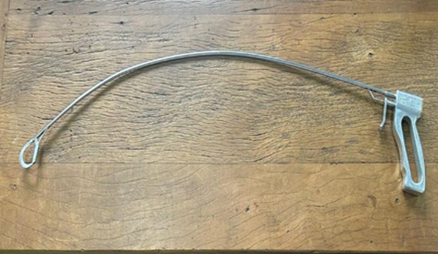
Epiglottic entrapment in horses is a condition that can cause intermittent respiratory obstruction, often observed during exercise. The aryepiglottic fold, which envelops the epiglottis, may become partially or completely entrapped, leading to respiratory difficulty and other clinical signs such as coughing and exercise intolerance. Diagnosis is primarily achieved through endoscopy and may be complemented by radiographic examination. Surgical correction is typically performed using transendoscopic techniques, such as transnasal axial division with a curved hook scalpel. A four-year-old, 450kg thoroughbred mare presented with decreased performance at the Jockey Club of São Paulo (Brazil). Following a clinical examination, epiglottic entrapment was diagnosed and treated through section of the aryepiglottic fold. The surgical procedure was performed endoscopically under sedation. The anesthetic protocol included detomidine, butorphanol, and 2% lidocaine, followed by analgesic and anti-inflammatory therapy and the application of Terra-Cortril Spray. Ten days later, a follow-up endoscopy revealed improved healing.
References
Amorim, R. A. R. (2018). Hemiplegia laríngea grau IV em equino: Relato de caso. Universidade Federal da Paraíba.
Barakzai, S. (2007). Handbook of Equine Respiratory Endoscopy. In Handbook of Equine Respiratory Endoscopy. https://doi.org/10.1016/B978-0-7020-2818-2.X5001-9.
Bergmann, I. M. (2020). Naturalness and the legitimacy of thoroughbred racing: A photo-elicitation study with industry and animal advocacy informants. Animals, 10(9). https://doi.org/10.3390/ani10091513.
Brito, E. L. R. (2001). Análise de características parentais e do produto no desempenho esportivo de cavalos puro sangue de corrida. Universidade Federal do Rio Grande do Sul.
Bruce, C., McGrorum, P. M., Robinson, N. E., & Schumacher, J. (2006). Equine Respiratory Medicina and Surgery. Philadelphia sunders.
Camp, M., Kibler, M. L., Ivey, J. L. Z., & Thompson, J. M. (2023). Factors Affecting Thoroughbred Online Auction Prices in Non/Post-Racing Careers. Animals, 13(8). https://doi.org/10.3390/ani13081329.
Davenport-Goodall, C. L. M., & Parente, E. J. (2003). Disorders of the larynx. Veterinary Clinics of North America - Equine Practice, 19(1), 169–187. https://doi.org/10.1016/S0749-0739(02)00072-X.
Dornbusch, P. T., Leite, S. C., Círio, S. M., Pimpão, C. T., Lunelli, D., Michellotto Junior, P. V, & Leite, L. C. (2008). Análise dos ruídos respiratórios de cavalos atletas no diagnóstico da hemiplegia de laringe. Archives of Veterinary Science, 13(3), 184–190. https://doi.org/10.5380/avs.v13i3.13134.
Ferraz, G. C., et al. (2009). Epiglottic entrapment in horses: Clinical presentation and outcome after transnasal axial division. Arquivo Brasileiro de Medicina Veterinária e Zootecnia, 61(6), 1443–1450.
Gramkov, H. L., & Evans, D. L. (2006). Correlação de ganhos de corrida com velocidade em frequência cardíaca máxima durante um teste de exercício de campo em cavalos de corrida puro-sangue. Equine Veterinary Journal, 36(Suppl.), 118–126.
Lacourt, M., & Marcoux, M. (2011). Treatment of Epiglottic Entrapment by Transnasal Axial Division in Standing Sedated Horses Using a Shielded Hook Bistoury. Veterinary Surgery, 40(3). https://doi.org/10.1111/j.1532-950X.2010.00781.x.
Laguna, G. G. L. (2006). Estudo Analítico dasendoscopias das vias aéreas de equinos PSI durante o período de 1993-2003 e avaliação dos resultados de procedimentos cirúrgicos laringeanos realizados no Jockey Club de São Paulo durante o período de 1998-2003. Universidade Estadual de São Paulo.
Lee, S. K., & Lee, I. (2019). Surgical corrections and postsurgical complications of epiglottic entrapment in Thoroughbreds: 12 cases (2009–2015). In Journal of Equine Science (Vol. 30, Issue 2, pp. 41–45). https://doi.org/10.1294/jes.30.41.
Lessa, D. A. B., Machado, C. H., Duarte, C. S., Wachholz, L., Lima, J. R. P. A., & Fernandes, W. R. (2005). Enfermidades do trato respiratório posterior em eqüinos de equitação no Rio de Janeiro: prevalência e aspectos clínico-laboratoriais. Revista Brasileira de Ciência Veterinária, 12(1–3), 77–83. https://doi.org/10.4322/rbcv.2014.308.
Mucciacito Júnior, D. A., Silva, L. C. L. C., & Oliveira, T. M. (2021). Relation between exercise-induced pulmonary hemorrhage and findings in upper airway and trachea in Thoroughbred racehorses. Revista Acadêmica Ciencia Animal, 19. https://doi.org/10.7213/ACAD.2021.19003.
Reed, S. M., Bayly, W. M., & Sellon, D. C. (2009). Equine internal medicine. Elsevier Health Sciences.
Rush, B., & Mair, T. (2007). Equine Respiratory Diseases. In Equine Respiratory Diseases. https://doi.org/10.1002/9780470752326.
Sprayberry, K. A., & Robinson, N. E. (2014). Robinson’s current therapy in equine medicine-E-Book. Elsevier Health Sciences.
Tate, L. P., Corbett, W. T., Bishop, B. J., & Foremann, J. H. (1993). Blood Gas Tensions, Acid‐base Status, Heart Rates, and Venous Profiles in Exercising Horses with Laryngeal Hemiplegia Before and After Corrective Surgery. Veterinary Surgery, 22(3). https://doi.org/10.1111/j.1532-950X.1993.tb00378.x.
Tate, L. P., Corbett, W. T., Foreman, J. H., Bishop, B. J., & Sweeney, C. L. (1993). Instrumentation of Exercising Thoroughbreds to Determine Blood Gas Tensions and Acid‐base Status. Veterinary Surgery, 22(3). https://doi.org/10.1111/j.1532-950X.1993.tb00377.x.
Thomassian, A. (2005). Enfermidades dos cavalos. Livraria Varela.
Tulleners, E. P. (1990). Transendoscopic contact neodymium:yttrium aluminum garnet laser correction of epiglottic entrapment in standing horses. Journal of the American Veterinary Medical Association, 196(12), 1971–1980. https://doi.org/10.2460/javma.1990.196.12.1971.
Vasconcellos, L. A. S. (2024). Alteração laríngea recorrente em equinos associada à compressão de nervos na região infra-auricular semelhante à Síndrome de Eagle em humanos: Relato de caso. PUBVET, 18(9), 1–5. https://doi.org/10.31533/pubvet.v18n09e1649.
Vasconcellos, L. A. S. (2019). Problemas respiratórios nos equinos e seus métodos de diagnóstico por imagens. Editora MedVet.
Verbridge, D. J., & Kirker-Head, C. A. (1988). Upper airway obstruction (partial asphyxia) as the possible cause of exercise-induced pulmonary hemorrhage in the horse: An hypothesis. Journal of Equine Veterinary Science, 8(1), 11–26. https://doi.org/10.1016/S0737-0806(88)80103-5.
Woodson, G. (2008). Management of neurologic disorders of the larynx. In Annals of Otology, Rhinology and Laryngology (Vol. 117, Issue 5). https://doi.org/10.1177/000348940811700501.
Downloads
Published
Issue
Section
License
Copyright (c) 2025 Hayza Hamazaki, Larissa Barbosa Lima , Gabriel Bottini da Silva

This work is licensed under a Creative Commons Attribution 4.0 International License.
Você tem o direito de:
Compartilhar — copiar e redistribuir o material em qualquer suporte ou formato
Adaptar — remixar, transformar, e criar a partir do material para qualquer fim, mesmo que comercial.
O licenciante não pode revogar estes direitos desde que você respeite os termos da licença. De acordo com os termos seguintes:
Atribuição
— Você deve dar o crédito apropriado, prover um link para a licença e indicar se mudanças foram feitas. Você deve fazê-lo em qualquer circunstância razoável, mas de nenhuma maneira que sugira que o licenciante apoia você ou o seu uso. Sem restrições adicionais
— Você não pode aplicar termos jurídicos ou medidas de caráter tecnológico que restrinjam legalmente outros de fazerem algo que a licença permita.