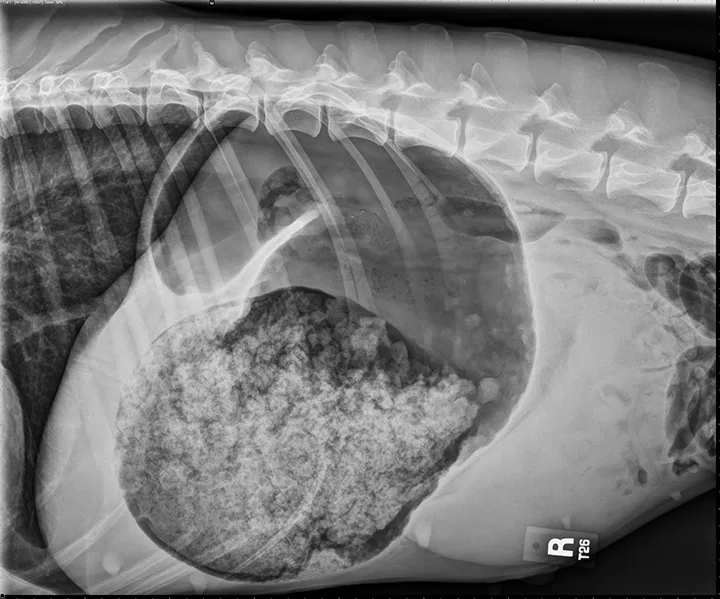
Gastric dilatation-volvulus in dogs
Review
DOI:
https://doi.org/10.31533/pubvet.v19n10e1845Keywords:
Dogs, surgery, dilatation, laparoscopic, gastropexy, breedsAbstract
Gastric dilatation-volvulus (GDV) is a severe and potentially fatal condition that primarily affects large and giant breed dogs. Prophylactic gastropexy has become established as the golden standard to reduce the risk of volvulus. This technique has an efficacy close to 100% in preventing stomach rotation (volvulus), although it does not eliminate the risk of simple gastric dilatation. In terms of safety, the surgery carries a very low risk of serious and direct complications, typically less than 5%. This study presents a literature review and a comparative analysis between animals undergoing prophylactic gastropexy and those treated on an emergency basis. The most effective techniques identified were incisional gastropexy and belt-loop gastropexy, both associated with low morbidity and excellent long-term outcomes. Patients undergoing the elective procedures, often combined with neutering, showed faster recovery, lower anesthetic risk, and better prognosis. It is concluded that prophylactic gastropexy should be strongly recommended for predisposed dogs, due to its safety, proven efficacy, and positive impact on quality of life.
References
Abou-Ashour, H. S. (2022). Impact of gastropexy/omentopexy on gastrointestinal symptoms after laparoscopic sleeve gastrectomy. Obesity Surgery, 32(3). https://doi.org/10.1007/s11695-021-05806-y.
Allen, P., & Paul, A. (2014). Gastropexy for prevention of gastric dilatation-volvulus in dogs: History and techniques. Topics in Companion Animal Medicine, 29(3). https://doi.org/10.1053/j.tcam.2014.09.001.
Aquere, N. L. R., Almeida, R. B. A., Souza, A. B., Santiago, M. F., Martins, É. G. N., Albuquerque, F. A. S. A., Martins, A. C. de P., Dias, P. G., Braga, J. dos R., Moreira, C. L., Queiroz, C. C. M. de, & Silva, E. A. T. (2025). Correção cirúrgica da síndrome de dilatação-vólvulo gástrica em cães: Eficácia e impacto das gastropexias preventivas. Brazilian Journal of Implantology and Health Sciences, 7(1), 834–840. https://doi.org/10.36557/2674-8169.2025v7n1p834-840
Baron, J. K., Casale, S. A., Monnet, E., Mayhew, P. D., Runge, J. J., Follette, C. M., Phipps, K., Powell, M. E., Reczynska, A. I., Squire, N. T., Barton, B. A., & Berg, J. (2020). Paramedian incisional complications after prophylactic laparoscopy-assisted gastropexy in 411 dogs. Veterinary Surgery, 49(S1). https://doi.org/10.1111/vsu.13348.
Bendinelli, C., Leonardi, F., Properzi, R., Giaconella, R., Poggi, E., Pozzuoli, S., & Cinti, F. (2023). Is pneumothorax secondary to pneumoperitoneum a real risk in dogs undergoing total laparoscopic gastropexy? Open Veterinary Journal, 13(2). https://doi.org/10.5455/OVJ.2023.v13.i2.8.
Benitez, M. E., Schmiedt, C. W., Radlinsky, M. A. G., & Cornell, K. K. (2013). Efficacy of incisional gastropexy for prevention of GDV in dogs. Journal of the American Animal Hospital Association, 49(3), 360–364. https://doi.org/10.5326/JAAHA-MS-5849.
Castro, N. B.; Boos, G. S.; Wurster, F.; Bassuino, D. M. (2013). Diagnóstico post mortem da síndrome dilatação vólvulo gástrica em cães. Acta Scientiae Veterinariae, 41, 1112–1120.
Coleman, K. A., Boscan, P., Ferguson, L., Twedt, D., & Monnet, E. (2019). Evaluation of gastric motility in nine dogs before and after prophylactic laparoscopic gastropexy: A pilot study. Australian Veterinary Journal, 97(7). https://doi.org/10.1111/avj.12829.
David, F., & Van Goethem, B. (2014). Laparoscopic gastropexy in dogs: A review of techniques and outcomes. Veterinary Comparative Orthopaedics and Traumatology, 27(5), 357–366. https://doi.org/10.3415/VCOT-14-03-0042
Dujowich, M., & Reimer, S. B. (2008). Prospective evaluation of two laparoscopic-assisted gastropexy techniques. Veterinary Surgery, 37(6), 656–662. https://doi.org/10.1111/j.1532-950X.2008.00432.x
Eggertsdóttir, A. V., Stigen, Ø., Lønaas, L., Langeland, M., Devor, M., Vibe-Petersen, G., & Eriksen, T. (2001). Comparison of the recurrence rate of gastric dilatation with or without volvulus in dogs after circumcostal gastropexy versus gastrocolopexy. Veterinary Surgery, 30(6). https://doi.org/10.1053/jvet.2001.28439.
Fossum, T. W. (2021). Cirurgia de pequenos animais (3ed.). Elsevier Editora.
Goethem, B. V. (2015). Minimally invasive surgical techniques in small animal practice: Gastropexy and beyond. Veterinary Clinics of North America: Small Animal Practice, 45(3), 703–722. https://doi.org/10.1016/j.cvsm.2015.01.009
Leonardi, F., Bianchi, E., & Zini, E. (2020). Laparoscopic-assisted gastropexy: Comparison between single-port and dual-port techniques in dogs. BMC Veterinary Research, 16(1), 215. https://doi.org/10.1186/s12917-020-02401-9
Leonardi, F., Properzi, R., Rosa, J., Boschi, P., Paviolo, S., Costa, G. L., & Bendinelli, C. (2020). Combined laparoscopic ovariectomy and laparoscopic-assisted gastropexy versus combined laparoscopic ovariectomy and total laparoscopic gastropexy: A comparison of surgical time, complications and postoperative pain in dogs. Veterinary Medicine and Science, 6(3). https://doi.org/10.1002/vms3.249.
Marki, P. (2021). Evaluation of long-term outcomes of laparoscopic-assisted gastropexy in dogs predisposed to gastric dilatation-volvulus. Veterinary Surgery, 50(5), 981–989. https://doi.org/10.1111/vsu.13613
Oliveira, A. L. (2022). Cirurgia veterinária em pequenos animais. Manole, São Paulo, Brasil.
Oliveira, D. V., Angelo, A. L. D., & Silva, A. A. B. (2020). Dilatação vólvulo gástrica em cão de pequeno porte: Relato de caso. PUBVET, 14(9), 1–5. https://doi.org/10.31533/pubvet.v14n9a660.1-5.
Ornellas, S. A., Bireahls, A. C., Meneguin, N. H., Sasahara, T. H. C., Moraes, P. C., Souza, M. L. R., & Leal, L. M. (2021). Evaluation of biomechanical traction of incisional gastropexy and scarification gastropexy techniques in dogs. Acta Scientiae Veterinariae, 49. https://doi.org/10.22456/1679-9216.110522.
Przywara, J. F., Abel, S. B., Peacock, J. T., & Shott, S. (2014). Occurrence and recurrence of gastric dilatation with or without volvulus after incisional gastropexy. Canadian Veterinary Journal, 55(10).
Raymundi, A. C.; Menezes, B. F.; Veloso, C. L. M.; Vieira, J. O. C.; Sousa, L. F.; Rodrigues, M. E. L.; Castro, T. A. L.; Silva, T. B. (2023). Síndrome da dilatação vólvulo gástrica em cães. Revista Foco, 16(10), e3473. 10.54751/revistafoco.v16n10-202.
Rawlings, C. A., Mahaffey, M. B., Bement, S., & Canalis, C. (2002). Prospective evaluation of laparoscopic-assisted gastropexy in dogs susceptible to gastric dilatation. Journal of the American Veterinary Medical Association, 221(11), 1576–1581. https://doi.org/10.2460/javma.2002.221.1576.
Willard, M. D. (2014). Surgical management of gastric dilatation-volvulus. In D. Slatter (Ed.), Textbook of small animal surgery (4th ed., pp. 1219–1227). Elsevier.
Wilson, E. R., Monnet, E., & Twedt, D. C. (2017). Laparoscopic-assisted gastropexy: Outcomes and complications in 212 dogs. Veterinary Surgery, 46(4), 499–506. https://doi.org/10.1111/vsu.12647
Våge, V., Behme, J., Jossart, G., & Andersen, J. R. (2020). Gastropexy predicts lower use of acid-reducing medication after laparoscopic sleeve gastrectomy. A prospective cohort study. International Journal of Surgery, 74. https://doi.org/10.1016/j.ijsu.2019.12.029.
Vega, M., & Ralphs, S. C. (2023). Outcomes and complications of prophylactic incisional gastropexy in 766 dogs (2009–2019). BMC Research Notes, 16(1). https://doi.org/10.1186/s13104-023-06595-6.
Downloads
Published
Issue
Section
License
Copyright (c) 2025 Tamires Yumi Freitas Carvalho, Carlos Roberto Venturini dos Santos, Leticia Cristina Vicco, Suellem Cristina da Silva Braga, Patrícia Franciscone Mendes

This work is licensed under a Creative Commons Attribution 4.0 International License.
Você tem o direito de:
Compartilhar — copiar e redistribuir o material em qualquer suporte ou formato
Adaptar — remixar, transformar, e criar a partir do material para qualquer fim, mesmo que comercial.
O licenciante não pode revogar estes direitos desde que você respeite os termos da licença. De acordo com os termos seguintes:
Atribuição
— Você deve dar o crédito apropriado, prover um link para a licença e indicar se mudanças foram feitas. Você deve fazê-lo em qualquer circunstância razoável, mas de nenhuma maneira que sugira que o licenciante apoia você ou o seu uso. Sem restrições adicionais
— Você não pode aplicar termos jurídicos ou medidas de caráter tecnológico que restrinjam legalmente outros de fazerem algo que a licença permita.