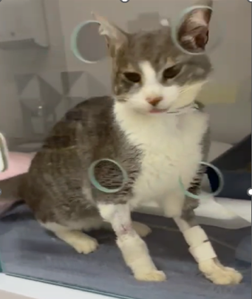
Neural therapy as a treatment for neurological sequelae caused by crotalic accident in a domestic feline: Case reportAbstract. Snakebite accidents in domestic animals are frequent events in Brazil and can cause severe clinical manifestations, especially when involving snakes of the Crotalus genus, whose venom exhibits neurotoxic, myotoxic, and anticoagulant effects. Neural therapy consists of the application of low-concentration local anesthetics at specific points on the patient, such as acupuncture points, scars considered interference fields, intravenous and intraperitoneal routes, ganglia, among others, with the aim of restoring cellular repolarization and modulating NMDA (N-methyl-D-aspartate) receptors. These receptors are involved in the regulation of cognition, attention, mood, anxiety, and basic functions such as locomotion and respiration. This paper reports the case of a domestic cat with neurological sequelae following a rattlesnake bite, presenting with paralysis of the facial and hypoglossal nerves, stupor, and prostration. The animal received an esophageal feeding tube and polyvalent antivenom, and 48 hours later underwent Neural Therapy (NT) with 0.7% procaine applied to acupuncture points and in the region of the submandibular lymph node. Twenty-four hours after the first application, significant improvement in responsiveness and motor functions was observed, allowing hospital discharge. After seven days, the swallowing reflex had recovered, enabling removal of the esophageal tube and an additional application targeting facial nerve paralysis. By day 14, the patient had achieved complete clinical recovery. NT showed potential as a complementary approach in the neurological rehabilitation following rattlesnake envenomation, and controlled studies are recommended to evaluate its therapeutic efficacy
Case report
DOI:
https://doi.org/10.31533/pubvet.v19n05e1771Keywords:
snakebite, cat, procaineAbstract
Snakebite accidents in domestic animals are common events in Brazil and can cause severe clinical manifestations, especially when involving snakes of the Crotalus genus, whose venom exhibits neurotoxic, myotoxic, and anticoagulant effects. Neural therapy consists of the application of low-concentration local anesthetics at specific points on the patient, such as acupuncture points, scars considered interference fields, intravenous and intraperitoneal routes, and ganglia, among others, with the aim of restoring cellular repolarization and modulating NMDA (N-methyl-D-aspartate) receptors. These receptors are involved in the regulation of cognition, attention, mood, anxiety and basic functions such as locomotion and respiration. This paper reports the case of a domestic cat with neurological sequelae following a rattlesnake bite, presenting with paralysis of the facial and hypoglossal nerves, stupor and prostration. The animal received an esophageal feeding tube and polyvalent antivenom and, 48 hours later, underwent Neural Therapy (NT) with 0.7% procaine applied to acupuncture points and in the region of the submandibular lymph node. Twenty-four hours after the first application, significant improvement in responsiveness and motor functions was observed, allowing for hospital discharge. After seven days, the swallowing reflex had recovered, allowing the removal of the esophageal tube and the administration of a new therapy session targeting facial nerve paralysis. By day 14, the patient had achieved complete clinical recovery. NT showed potential as a complementary approach in neurological rehabilitation following rattlesnake envenomation, and controlled studies are recommended to evaluate its therapeutic efficacy.
References
Azevedo-Marques, M. M., Cupo, P., & Hering, S. E. (2003). Acidentes por animais peçonhentos: serpentes peçonhentas. Medicina (Ribeirão Preto), 36(2/4), 480–489.
Bernarde, P. S., & Gomes, J. O. (2012). Serpentes peçonhentas e ofidismo em Cruzeiro do Sul, Alto Juruá, estado do Acre, Brasil. Acta Amazônica, 42, 65–72.
Bernardi, E., Dallasta, L. B., Martins, D. B., Noronha, F., Oliveira, M., Oliveira, E. Z., Alcântara, P., Previati, B. B., Reolon, M., & Silva, A. A. (2011). Acidente ofídico em cão: Relato de caso. Resumos do XVI Seminário Interinstitucional de Ensino, Pesquisa e Extensão da UNICRUZ, 1–4.
Bochner, R., & Struchiner, C. J. (2002). Acidentes por animais peçonhentos e sistemas nacionais de informação. Cadernos de Saúde Pública, 18, 735–746.
Bulcão, R. P., Arbo, M. D., Rohers, M., Paniz, C., Cervi, L., F., Thiesen, F. V, Leal, M. B., & Garcia, S. C. (2011). Procaína: Efeitos farmacológicos e toxicológicos. Revista de Ciências Farmacêuticas Básica e Aplicada, 32(3), 297–303.
Cintra, C., Dias, L. G., Júnior, D. P., Pereira, L., & Dias, F. (2014). Acidentes ofídicos em animais domésticos. Enciclopédia Biosfera, 10(18), 58–71.
Dueñas-González, A., García-López, P., Herrera, L. A., Medina-Franco, J. L., González-Fierro, A., & Candelaria, M. (2008). The prince and the pauper. A tale of anticancer targeted agents. Molecular Cancer, 7(82). https://doi.org/10.1186/1476-4598-7-82.
Faria, A. B., & Scognamillo-Szabóo, M. V. R. (2008). Acupuntura veterinária: Conceitos e técnicas – Revisão. ARS Veterináaria, 24(2).
Fernandes, T. A., Aguiar, C. N., & Daher, E. F. (2008). Envenenamento crotálico: Epidemiologia, insuficiência renal aguda e outras manifestações clínicas. Revista Eletrônica de Pesquisa Médica, 2, 1–10.
FUNASA. (2001). Manual de diagnóstico e tratamento de acidentes por animais peçonhentos (Vol. 1). Ministério da Saúde.
Gomes, R. C. B. (2008). Acidente botrópico, elapídico e crotálico em cães e gatos. Universidade Castelo Branco.
Gonçalves, B. A. L., Vianna, L. R., & Andrade, C. C. (2020). Terapia Neural: uma opção de tratamento em pacientes oncológicos. Reviews Multidisciplinary, 3(e2020014). https://doi.org/10.29327/multi.2020014
Gonçalves, B. A. L., Vianna, L. R., Mendes, A. C. R., & Almeida, C. A. (2021). Tratamento com terapia neural em cão com discopatia: Relato de caso. PUBVET, 15(5), 1–6. https://doi.org/10.31533/pubvet.v15n05a816.1-6.
Gonda, X. (2012). Basic pharmacology of NMDA receptors. Current Pharmaceutical Design, 18(12), 1568–1567. https://doi.org/10.2174/138161212799958521.
Graça, F. A. S., Peixoto, P. V., Coelho, C. D., Caldas, S. A., & Tokarnia, C. H. (2008). Aspectos clínico-patológicos e laboratoriais do envenenamento crotálico experimental em bovinos. Pesquisa Veterinária Brasileira, 28(6). https://doi.org/10.1590/s0100-736x2008000600001.
Hiinarejos, D. P., Hernández-Divers, S. M., & Hernández-Divers, S. J. (2006). Ofídios. In R. Aguilar, S. M. Hernández-Divers, & S. M. Hernández-Divers (Eds.), Atlas de Medicina, Terapêutica e Patologia de Animais Exóticos. Interbook.
Hwang, Y. C. (1992). Anatomy and classification of acupoints. Problems in Veterinary Medicine, 4(1), 12.
Illera, J. C. J., & Cárdenas, M. L. (2011). Procaína, epigenética y terapia neural en el cáncer: una alternativa terapéutica? Revista Médicas UIS, 24(2), 173–180.
Lopes, C. T. A., Tokarnia, C. H., Brito, M. F., Sousa, M. G. S., Oliveira, C. M. C., Silva, N. D. S., Lima, D. H. S., & Barbosa, J. D. (2012). Aspectos clínico-patológicos e laboratoriais do envenenamento crotálico experimental em equinos. Pesquisa Veterinária Brasileira, 32(9). https://doi.org/10.1590/S0100-736X2012000900005.
Lucena Júnior, L. C., Lopes, E. B., Santos, C. M., Valois, A. A. C., Menezes, N. J., Santana, S. S., & Lima, I. S. S. (2021). Tratamento integrativo homeopático e farmacopuntura com Viscum album em carcinoma mamário canino: Relato de caso. PUBVET, 15(6), 1–9. https://doi.org/10.31533/pubvet.v15n06a835.1-9.
Matos, R. R., & Ignotti, E. (2020). Incidência de acidentes ofídicos por gêneros de serpentes nos biomas brasileiros. Ciência & Saúde Coletiva, 25(7). https://doi.org/10.1590/1413-81232020257.31462018
Quessada, A. M., Oliveira Drumond, K., Batista Filho, D., Klein, R. P., Souza, J. M., & Barreto, F. M. (2011). Farmacopuntura com acepromazina para tranquilização de suínos. Semina: Ciências Agrárias, 32(1), 287–293. https://doi.org/10.5433/1679-0359.2011v32n1p287.
Romero, A. C. M., Carvalho, A. F. A. & Araújo, L. V. C. (2019). Uso da farmacopuntura em pequenos animais com distúrbios locomotores: revisão de literatura. Revista Brasileira de Terapias Complementares, 17(2), 55–62.
Scognamillo-Szabó, M. V. R., & Bechara, G. H. (2010). Acupuntura: Histórico, bases teóricas e sua aplicação em medicina veterinária. Ciência Rural, 40(2). https://doi.org/10.1590/s0103-84782010005000004.
Tokarnia, C. H., & Peixoto, P. V. (2006). A importância dos acidentes ofídicos como causa de mortes em bovinos no Brasil. In Pesquisa Veterinária Brasileira (Vol. 26, Issue 2). https://doi.org/10.1590/S0100-736X2006000200001
Tolentino, L. H. O., Tolentino, M. L. D. L., Assis, D. M., Firmino, M. O., Benvenutti, M. E. M., Miranda Neto, E. G., Dantas, A. F. M., & Vaz, A. F. M. (2019). Caracterização clínica, laboratorial e patológica de equino naturalmente acometido por acidente botrópico. PUBVET, 13(4), 1–8. https://doi.org/10.31533/pubvet.v13n4a309.1-8
Veternet, C. (2015). Acupuntura veterinaria ¿Mito, moda o realidad? Veternet Chile, 1.
Vianna, L. R., & Gonçalves, B. A. L. (2016). Nasce uma nova especialidade na Medicina Veterinaria Brasileira: Terapia Neural e Odontologia NeuroFocal. Revista Veterinária e Zootecnia, 130, 16–21.
Vianna, L. R., & Gonçalves, B. A. L. (2017). Entenda a terapia neural. Revista CFMV, 74, 44–47.
Vianna, L. R., & Gonçalves, B. A. L. (2020). pH e condutividade do cloridrato de procaína em diferentes concentrações utilizadas na terapia neural. Multidisciplinary Science Journal, 2(e2021002:), 1–5. https://doi.org/10.29327/multiscience.2021002.
Vinyes, D., Muñoz-Sellart, M., & Caballero, T. G. (2022). Local anesthetics as a therapeutic tool for post COVID-19 patients: A case report. Medicine (United States), 101(28), e29358.23. https://doi.org/10.1097/MD.0000000000029358,
Wang, X. L., Zhang, T. F., Zhang, H. X., Mao, H. R., & Huang, G. F. (2007). Therapeutic effects of acupoint injection at cervical Jiaji points and effects on ET and CGRP in the patient of ischemic stroke. Zhongguo Zhen Jiu. Chinese Acupuncture & Moxibustion, 27(2), 93.
Weg. (1994). Veterinary acupuncture: Ancient art to modern medicine. Journal of Equine Veterinary Science, 14(6), 55–68. https://doi.org/10.1016/s0737-0806(06)82070-8.
Xie, H., & Preast, V. (2011). Acupuntura veterinária xie. MED VET Livros.
Zhou, W., Fu, L. W., Tjen-A-Looi, S. C., Li, P., & Longhurst, J. C. (2005). Afferent mechanisms underlying stimulation modality-related modulation of acupuncture-related cardiovascular responses. Journal of Applied Physiology, 98(3), 872–880. https://doi.org/10.1152/japplphysiol.01079.2004.
Downloads
Published
Issue
Section
License
Copyright (c) 2025 Maria Isabel Sousa Paiva, Maria Luísa de Cápua, Talita Thomaz Nader

This work is licensed under a Creative Commons Attribution 4.0 International License.
Você tem o direito de:
Compartilhar — copiar e redistribuir o material em qualquer suporte ou formato
Adaptar — remixar, transformar, e criar a partir do material para qualquer fim, mesmo que comercial.
O licenciante não pode revogar estes direitos desde que você respeite os termos da licença. De acordo com os termos seguintes:
Atribuição
— Você deve dar o crédito apropriado, prover um link para a licença e indicar se mudanças foram feitas. Você deve fazê-lo em qualquer circunstância razoável, mas de nenhuma maneira que sugira que o licenciante apoia você ou o seu uso. Sem restrições adicionais
— Você não pode aplicar termos jurídicos ou medidas de caráter tecnológico que restrinjam legalmente outros de fazerem algo que a licença permita.